
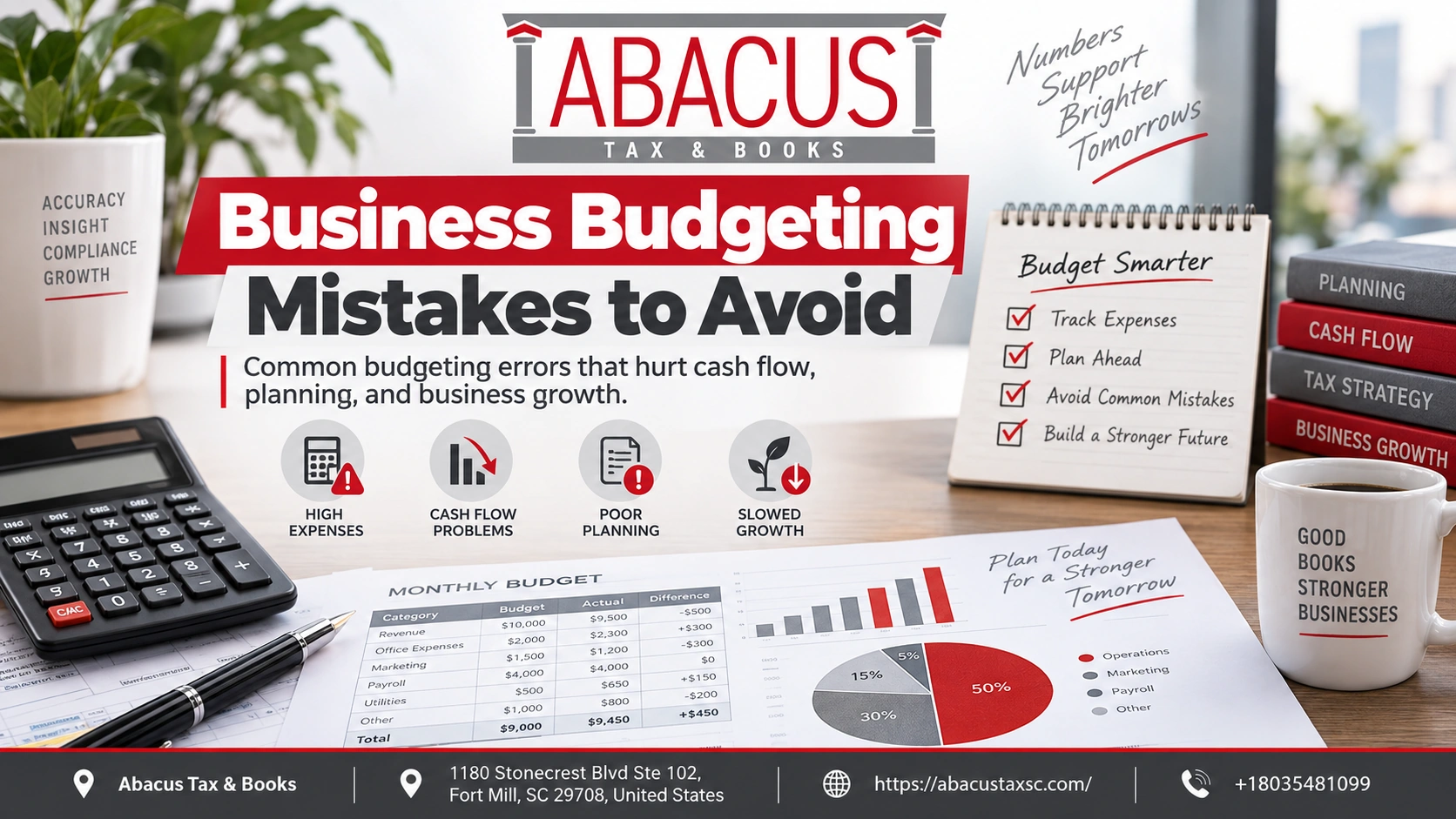
Business Budgeting Mistakes to Avoid
Business budgeting mistakes can leave a company short on cash even when sales appear healthy. Overestimating revenue, overlooking expenses, failing to prepare for taxes, and relying on outdated financial information can all create avoidable financial pressure.
A useful business budget should reflect what is actually happening in the company, not what the owner hopes will happen. At Abacus Tax & Books, we encourage business owners to treat budgeting as an ongoing financial planning process supported by accurate bookkeeping, cash flow information, and regular financial reports.
Why Business Budgeting Matters
A business budget gives owners a framework for deciding how much money can reasonably be spent, saved, reinvested, or reserved.
Without one, financial decisions often become reactive.
A company may approve a new hire, purchase equipment, increase advertising, or take on additional overhead without clearly understanding how those expenses will affect available cash during slower months.
A well-prepared budget can help a business:
- Estimate future income and expenses
- Prepare for recurring financial obligations
- Identify potential cash shortages
- Set spending priorities
- Plan for taxes
- Evaluate whether expansion is affordable
- Compare actual financial performance with expectations
- Make decisions based on numbers rather than assumptions
Budgeting does not guarantee that every month will go according to plan. Revenue may fluctuate, expenses may increase, and unexpected costs can arise.
The value of a budget is that it provides a financial baseline against which those changes can be measured.
Common Business Budgeting Mistakes to Avoid
Most budgeting problems are not caused by complicated accounting issues.
They often begin with simple assumptions that turn out to be inaccurate.
Some of the most common business budgeting mistakes include:
- Setting unrealistic revenue targets
- Leaving out smaller recurring expenses
- Focusing on profit while ignoring cash flow
- Forgetting seasonal changes
- Failing to reserve money for taxes
- Having no emergency cushion
- Using outdated bookkeeping information
- Creating a budget once and never reviewing it
- Ignoring financial statements
- Mixing personal and business spending
Any one of these problems can reduce the usefulness of a budget.
Several occurring at the same time can make financial planning especially difficult.
Overestimating Revenue
Revenue projections are one of the most important parts of a business budget, but they are also one of the easiest areas to get wrong.
Optimism is natural when planning for growth.
The problem occurs when expected growth is treated as guaranteed income.
For example, a business may assume that revenue will increase by 25% because:
- A new marketing campaign is launching
- Additional sales staff were hired
- The company entered a new market
- A large proposal is awaiting approval
- The previous year ended strongly
Those factors may support growth, but they do not guarantee it.
If spending decisions are based on revenue that never arrives, the business can quickly experience cash flow pressure.
Use Historical Data as a Starting Point
Past financial performance can provide a more reliable baseline.
Review:
- Monthly revenue
- Year-over-year changes
- Average transaction value
- Customer retention
- Sales trends
- Seasonal fluctuations
Historical data should not automatically determine the future, but it can help identify whether revenue expectations are realistic.
Build Conservative Projections
Consider creating more than one revenue scenario.
For example:
- Conservative forecast
- Expected forecast
- Strong-growth forecast
This gives the business a better understanding of what expenses are sustainable under different revenue conditions.
Underestimating Business Expenses
Revenue tends to receive more attention during budgeting, but expense projections are equally important.
Businesses often remember their largest expenses, such as:
- Payroll
- Rent
- Inventory
- Insurance
- Equipment
- Advertising
Smaller expenses can be easier to overlook.
These might include:
- Software subscriptions
- Bank charges
- Payment processing fees
- Office supplies
- Vehicle expenses
- Professional memberships
- Licenses
- Shipping
- Repairs
- Employee training
- Merchant fees
- Technology replacements
Individually, these expenses may appear minor.
Combined over 12 months, they can represent a meaningful portion of operating costs.
Review Actual Spending Before Building the Budget
Rather than estimating expenses from memory, review recent financial records.
Look at several months of transactions and categorize where the money is actually going.
Accurate bookkeeping makes this significantly easier because expenses are already organized into useful categories.
Forgetting Seasonal Cash Flow Changes
A profitable business can still experience periods of tight cash flow.
This is especially common for seasonal businesses.
Revenue may be concentrated during certain months while many expenses continue throughout the year.
For example, a company might generate most of its sales during spring and summer but still need to pay:
- Rent
- Insurance
- Salaries
- Software subscriptions
- Loan payments
- Utilities
during slower winter months.
Other businesses may experience predictable increases in spending before their busiest seasons.
Inventory may need to be purchased weeks or months before customers generate the revenue that pays for it.
Budget Month by Month
An annual budget can hide seasonal problems.
A business might appear profitable when viewed across 12 months while still facing severe cash shortages during individual months.
Monthly budgeting makes it easier to identify those periods in advance.
Look at:
- Historical monthly revenue
- Seasonal expenses
- Customer payment timing
- Inventory purchasing periods
- Major annual bills
- Payroll changes
Understanding timing is just as important as understanding totals.
Failing to Budget for Taxes and Unexpected Costs
Taxes should not be treated as an expense that appears unexpectedly.
Yet many small businesses fail to reserve enough money throughout the year.
Depending on the business structure and circumstances, obligations may include:
- Estimated income taxes
- Payroll taxes
- Sales taxes
- State taxes
- Local taxes
- Business licensing costs
Waiting until a payment deadline approaches can create unnecessary pressure on working capital.
Setting aside money throughout the year can make tax obligations more manageable.
Build a Financial Buffer
Unexpected costs are also unavoidable in business.
Equipment breaks.
Vehicles require repairs.
Insurance premiums increase.
Customers pay late.
Technology needs replacement.
Suppliers change pricing.
A budget with no room for unexpected expenses assumes that everything will go exactly as planned.
That rarely happens.
Creating a contingency category or maintaining an appropriate cash reserve can give the business greater flexibility when something changes.
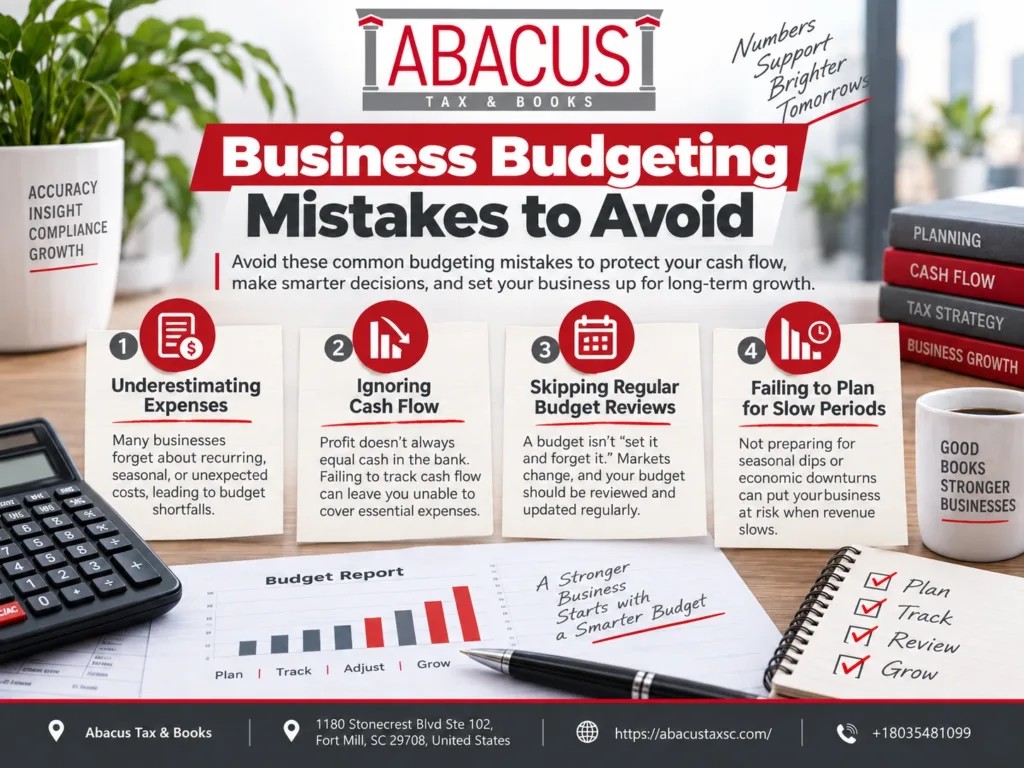
Not Reviewing the Budget Regularly
A budget should not be created in January and ignored until December.
The assumptions behind it may become outdated within months.
Sales may perform better than expected.
Costs may increase.
A customer may leave.
Payroll may change.
A new contract may significantly increase revenue.
Business owners should compare actual performance with budgeted figures regularly.
For many businesses, a monthly review provides a useful rhythm.
Compare Budget Versus Actual Results
Ask questions such as:
- Did revenue meet expectations?
- Which expenses were higher than planned?
- Were any costs lower than expected?
- Has cash flow changed?
- Are customers taking longer to pay?
- Are upcoming expenses adequately funded?
- Does the remainder of the year’s budget still make sense?
These comparisons turn a budget into an active management tool.
Without regular review, the budget becomes little more than an old spreadsheet.
Ignoring Financial Reports When Budgeting
A strong business budget should be supported by reliable financial information.
Guessing is rarely enough.
Several financial reports can provide important budgeting insights.
Profit and Loss Statement
A profit and loss statement shows revenue and expenses over a specific period.
It can help owners understand:
- Which expenses consume the most money
- Whether revenue is increasing or declining
- How profitability has changed
- Which costs may need closer attention
Looking at several periods can reveal trends that should influence the next budget.
Balance Sheet
A balance sheet provides a snapshot of what the business owns and owes.
It includes items such as:
- Cash
- Accounts receivable
- Equipment
- Loans
- Accounts payable
- Other liabilities
- Owner equity
This information can be especially useful when planning debt payments, major purchases, or future financing.
Cash Flow Information
Profit and cash are not the same thing.
A company may report revenue before all of that money has actually been collected.
Meanwhile, bills still need to be paid.
Cash flow analysis can help owners understand when money enters and leaves the business.
Accounts Receivable Reports
If customers are regularly paying late, projected revenue may not translate into available cash when expected.
Reviewing outstanding invoices helps owners budget based on realistic collection timing.
Financial reports provide the evidence behind stronger budgeting decisions.
Best Practices for Creating a Better Business Budget
A useful budget does not need to be overly complicated.
It does need to be realistic and based on dependable information.
Start with these practices.
Use Recent Financial Data
Build the budget using actual revenue and expense information from previous months or years.
Look for trends rather than relying solely on one unusually strong or weak period.
Separate Fixed and Variable Costs
Fixed costs generally remain relatively consistent.
Examples may include:
- Rent
- Certain insurance policies
- Software subscriptions
- Loan payments
Variable costs change as business activity changes.
Examples might include:
- Materials
- Shipping
- Commissions
- Certain labor costs
- Payment processing fees
Separating these categories makes it easier to see which expenses can change if revenue declines.
Create Monthly Projections
Break the budget into individual months instead of relying only on annual totals.
This helps reveal seasonal cash flow gaps.
Include a Contingency
Unexpected costs should be expected.
Set aside room in the budget for repairs, price increases, emergencies, and other unforeseen expenses.
Plan for Taxes
Treat taxes as an ongoing financial obligation rather than a last-minute expense.
Review Actual Results
Compare real financial performance with the budget at regular intervals.
Update Assumptions
A budget should change when the business changes.
Adjust projections when new information becomes available.
How Accounting Services Support Better Budgeting
Good budgeting depends heavily on good financial information.
If bookkeeping is months behind or transactions are incorrectly categorized, business owners may be building a budget using incomplete numbers.
Accounting and bookkeeping services can help establish a clearer financial picture.
At Abacus Tax & Books, accurate records can help business owners better understand:
- How much revenue the business is actually generating
- Where operating expenses are increasing
- Which months tend to be stronger or weaker
- How much customers currently owe
- What financial obligations are approaching
- Whether spending aligns with business performance
- How actual results compare with expectations
Regular reporting can also help identify problems earlier.
If an expense category begins rising unexpectedly, the business owner can investigate before it becomes a larger issue.
If revenue falls below forecast for several months, spending plans can be reconsidered.
Budgeting becomes far more useful when the numbers behind it are accurate and current.
Build a Business Budget Around Reliable Financial Information
A business budget should help owners make decisions with greater confidence, not simply satisfy an annual planning exercise.
Avoiding unrealistic revenue expectations, overlooked expenses, seasonal cash flow gaps, and insufficient tax planning can make the budget much more useful throughout the year.
Just as importantly, budgeting should be supported by current financial records.
At Abacus Tax & Books, we help small business owners maintain organized financial information so they can better understand where their money is going and make informed decisions about what comes next.
Whether you need help improving your bookkeeping, understanding financial reports, preparing for taxes, or gaining a clearer picture of your business finances, accurate records provide the foundation.
Contact Abacus Tax & Books to discuss how better bookkeeping and accounting support can help strengthen your business planning.
FAQs
What is the most common business budgeting mistake?
One of the most common mistakes is creating a budget based on overly optimistic revenue projections. If sales fall below expectations while expenses remain unchanged, cash can quickly become tight. Using historical financial data and conservative projections can make budgeting more realistic.
How often should a small business review its budget?
Many small businesses benefit from reviewing their budgets monthly. Regular reviews allow owners to compare actual revenue and expenses with projections and adjust their plans if conditions change. Businesses experiencing rapid growth or significant cash flow changes may need to review their numbers even more frequently.
Should a business budget include unexpected expenses?
Yes. Building a contingency into the budget can help the company handle equipment repairs, supplier increases, emergencies, or other unplanned costs without immediately disrupting normal operations.
Why is cash flow important when creating a budget?
A business may record revenue before the cash is actually received. At the same time, expenses may need to be paid immediately. Reviewing cash flow helps business owners understand when money will realistically be available rather than looking only at reported sales or profit.
Which financial reports are most useful for budgeting?
Profit and loss statements, balance sheets, cash flow information, accounts receivable reports, and detailed expense records can all support budgeting. Together, they help owners understand income, spending, outstanding obligations, available resources, and financial trends.
Can an accountant or bookkeeper help create a better business budget?
Accounting and bookkeeping support can make budgeting more reliable by ensuring the underlying financial records are accurate and current. Professionals can also help business owners understand reports, identify spending trends, evaluate cash flow, and compare actual performance with financial projections.