
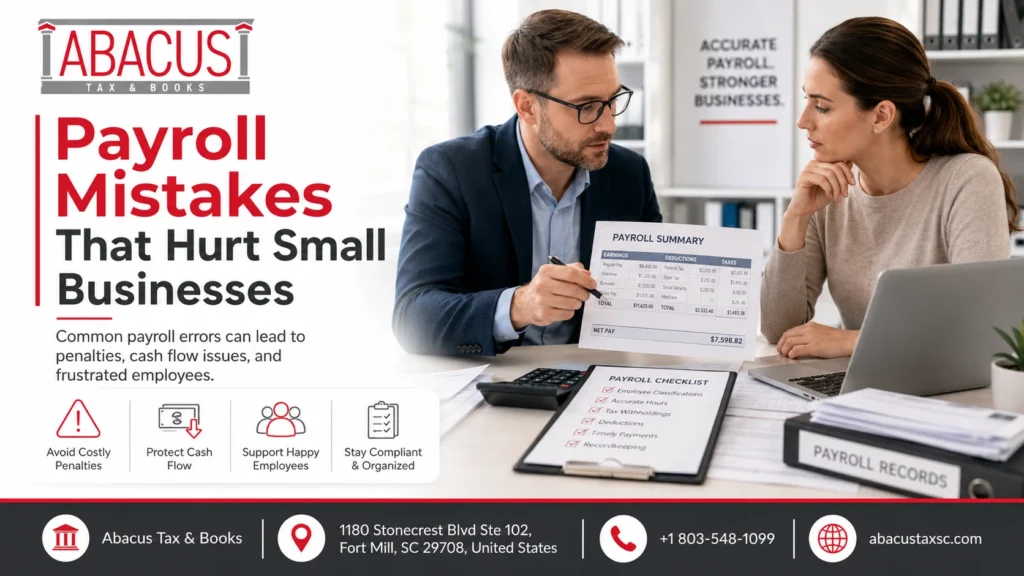
Payroll Mistakes That Hurt Small Businesses
Payroll mistakes can cost a small business far more than the amount shown on an incorrect paycheck. Errors involving wages, taxes, overtime, employee classification, filing deadlines, or payroll records can affect employees while also creating tax and compliance problems for the business.
For small business owners, payroll becomes easier to manage when there are consistent processes for tracking hours, reviewing payroll, maintaining records, and reconciling payroll activity with the books. Understanding the most common payroll mistakes that hurt small businesses is an important first step toward preventing expensive problems.
Why Payroll Accuracy Matters for Small Businesses
Payroll is one of the most important financial responsibilities a small business manages.
Employees depend on their paychecks being accurate and arriving on time. Government agencies expect businesses to properly calculate, report, deposit, and document payroll taxes. Business owners also need reliable payroll information to understand labor costs and maintain accurate financial records.
Even relatively small payroll errors can create larger problems when they continue for several pay periods.
Common consequences may include:
- Employees being overpaid or underpaid
- Incorrect payroll tax deposits
- Penalties and interest
- Problems with quarterly or annual payroll reports
- Inaccurate accounting records
- Employee complaints or disputes
- Additional administrative work
- Difficulty reconciling payroll and bank accounts
Accurate payroll therefore requires more than simply issuing checks or direct deposits. Businesses need a process that connects employee information, timekeeping, payroll calculations, tax reporting, and bookkeeping.
Misclassifying Employees and Independent Contractors
Worker classification is one of the most significant payroll issues a small business can encounter.
Employees and independent contractors are generally treated differently for payroll and tax purposes. Employers typically withhold applicable payroll taxes from employee wages, while independent contractors generally handle their own tax obligations.
Problems arise when a worker is treated as an independent contractor even though the working relationship should be classified as employment under applicable rules.
Classification is not determined simply by what the business calls the worker.
Depending on the situation, factors may include:
- How much control the business has over the worker
- How the work is performed
- The financial relationship between the parties
- Whether the worker operates an independent business
- The nature and duration of the working relationship
Misclassification can potentially result in unpaid payroll taxes, penalties, interest, wage disputes, or other compliance issues.
Small businesses should review worker classifications carefully rather than assuming that paying someone on a contract basis automatically makes that person an independent contractor.
Because classification rules can depend on federal, state, and local requirements, businesses should seek qualified professional guidance when a worker’s status is unclear.
Missing or Incorrect Payroll Tax Withholdings
Another common payroll mistake involves withholding the wrong amount of tax from an employee’s wages.
Payroll calculations may involve several types of taxes depending on the employee and the business’s location.
Problems can occur when:
- Employee information is entered incorrectly
- Tax elections are outdated
- Payroll software settings are incorrect
- State or local tax requirements are overlooked
- Payroll changes are entered manually without proper review
- New employees are set up incorrectly
An incorrect withholding amount may affect both the employee and the business.
Employees may notice that their take-home pay is unexpectedly high or low. The business may later discover that payroll tax liabilities do not match what was withheld or deposited.
Employers should make sure employee payroll information is entered accurately and updated when employees submit appropriate changes.
Payroll reports should also be reviewed regularly rather than assuming every automated payroll calculation is correct.
Paying Employees Late or the Wrong Amount
Few payroll errors affect employees as directly as receiving the wrong paycheck.
Employees have household expenses, bills, loan payments, and other financial obligations that often depend on predictable pay dates.
Common payroll payment errors include:
- Missing hours
- Incorrect hourly rates
- Incorrect salary amounts
- Missing bonuses
- Incorrect commissions
- Improper deductions
- Duplicate payments
- Missing reimbursements
- Incorrect paid leave calculations
Businesses should establish a payroll review process before payments are finalized.
For example, comparing the current payroll with the previous pay period can help identify unusual changes. A large increase or decrease in an employee’s pay should be investigated before payroll is submitted.
Changes involving raises, bonuses, deductions, benefits, or employee status should also be documented and reviewed.
When a payroll mistake does occur, businesses should address it promptly and maintain documentation explaining what happened and how it was corrected.
Failing to Track Overtime and Employee Hours Correctly
Accurate timekeeping is essential for businesses with hourly or overtime-eligible employees.
Relying on handwritten notes, employee memory, text messages, or informal schedules can make payroll much harder to verify.
A reliable timekeeping system should record information such as:
- Clock-in times
- Clock-out times
- Total hours worked
- Overtime hours
- Breaks when applicable
- Paid leave
- Schedule adjustments
Employers also need to understand which employees may qualify for overtime and how overtime rules apply.
One common mistake is assuming that paying an employee a salary automatically removes overtime requirements. Employee exemption status generally depends on applicable legal requirements and the employee’s duties, compensation structure, and other factors.
Businesses should avoid making overtime assumptions without reviewing the relevant requirements.
Good timekeeping provides another important benefit: documentation.
If a question later arises regarding an employee’s wages or hours, organized time records can help the business determine exactly what was reported and paid.
Missing Payroll Tax Filing and Deposit Deadlines
Businesses may be responsible for filing payroll tax returns and depositing payroll taxes according to established schedules.
Missing those deadlines can potentially result in penalties and interest.
Payroll responsibilities may include:
- Federal payroll tax deposits
- Federal payroll tax filings
- State payroll tax deposits
- State payroll reports
- Local payroll obligations
- Unemployment-related filings
- Year-end employee forms
- Contractor reporting when applicable
The specific deadlines and requirements depend on the business.
Small business owners sometimes encounter problems because they assume that filing a payroll tax return and depositing payroll taxes happen at the same time. In many situations, deposits and reports follow different schedules.
A payroll calendar can help prevent missed dates.
Businesses can document each filing deadline, payment deadline, reporting requirement, and year-end responsibility so important tasks are not dependent on memory.
Poor Payroll Recordkeeping and Documentation
Payroll records provide evidence of how employees were paid and how payroll amounts were calculated.
Incomplete records can make payroll problems much more difficult to resolve.
Businesses should maintain organized documentation related to areas such as:
- Employee information
- Pay rates
- Hours worked
- Payroll reports
- Payroll tax filings
- Tax deposits
- Bonuses
- Commissions
- Payroll deductions
- Benefits
- Paid time off
- Wage changes
Documentation is particularly important when employee compensation changes.
If an employee receives a raise, for example, the business should have a clear record of when the new rate became effective.
Payroll records should also match the business’s accounting records.
When payroll reports show one amount but the general ledger shows another, the discrepancy should be investigated instead of carried forward into future periods.
Mixing Payroll With Other Business Expenses
Payroll should be clearly identified within a company’s financial records.
Mixing wages, payroll taxes, reimbursements, owner payments, contractor payments, and unrelated operating expenses can make financial statements difficult to understand.
For example, businesses should be able to identify amounts related to:
- Gross wages
- Employer payroll taxes
- Employee tax withholdings
- Payroll liabilities
- Employee benefits
- Contractor payments
- Reimbursements
Clear categorization makes bookkeeping reconciliation easier and gives business owners a better picture of their actual labor costs.
Mixing payroll with unrelated expenses can also make tax preparation more complicated because additional work may be required to determine what each transaction represents.
Consistent bookkeeping helps keep payroll activity traceable.
Common Payroll Compliance Mistakes
Payroll compliance involves several responsibilities, and requirements can vary depending on the business, employees, and jurisdiction.
Some of the most common payroll compliance mistakes include:
Using outdated employee information
Changes to tax elections, addresses, pay rates, or employee status should be updated promptly.
Incorrectly calculating overtime
Overtime calculations should follow applicable wage and hour rules.
Failing to maintain required payroll records
Businesses should understand which payroll and employment documents they are required to retain and for how long.
Missing required payroll filings
Federal, state, or local reporting requirements may apply depending on where the business operates.
Incorrect worker classification
Employees and independent contractors should be classified based on applicable requirements rather than convenience.
Improper payroll deductions
Businesses should confirm that deductions from employee wages are permitted and processed correctly.
Payroll requirements can vary considerably by location and business structure. A process that works for one employer may not necessarily meet another employer’s obligations.
When questions involve wage rules, tax requirements, worker classification, or other compliance matters, obtaining guidance from a qualified professional can help prevent costly assumptions.
How to Prevent Costly Payroll Errors
Many payroll problems can be prevented through consistent processes.
Businesses do not necessarily need a complicated system. They need a system that is accurate, documented, and followed consistently.
Use reliable time tracking
Employees should have a clear method for recording their working hours. Supervisors should review unusual entries before payroll is processed.
Review payroll before submitting it
Check payroll totals, employee hours, wages, deductions, bonuses, and significant changes.
Maintain a payroll calendar
Record important payroll processing dates, tax deposit deadlines, reporting deadlines, and year-end responsibilities.
Document employee changes
Raises, bonuses, deductions, benefits, schedule changes, and employment status changes should be documented.
Reconcile payroll regularly
Payroll reports should be compared with accounting records, payroll liabilities, and bank transactions.
Review employee classifications
Periodically confirm that employees and contractors continue to be classified appropriately.
Keep records organized
Payroll records should be easy to locate if an employee, accountant, tax professional, or government agency needs additional information.
Regular payroll reviews can catch small discrepancies before they develop into larger problems.
How Accounting and Bookkeeping Support Accurate Payroll
Payroll and bookkeeping should work together.
Payroll determines what employees receive and what taxes or liabilities the business owes. Bookkeeping records those transactions within the company’s financial system.
When the two are disconnected, discrepancies can easily go unnoticed.
For example, a payroll report might show $15,000 in payroll expenses while the accounting system records $14,500. That difference needs to be identified and explained.
Regular payroll reconciliation can help confirm that:
- Payroll expenses are recorded correctly
- Payroll tax liabilities match payroll reports
- Tax payments are properly recorded
- Employee payments match bank activity
- Payroll-related expenses are categorized correctly
- Outstanding payroll liabilities are identified
Accurate bookkeeping also helps business owners understand how payroll affects profitability and cash flow.
Labor is often one of a small business’s largest expenses. When payroll information is accurate, owners can make better decisions regarding hiring, pricing, budgeting, staffing, and future growth.
At Abacus Tax & Books, we believe payroll should not operate as a completely separate financial function. Payroll, bookkeeping, accounting records, and tax reporting should support one another so business owners have a clearer picture of their finances.
FAQs
What are the most common payroll mistakes small businesses make?
Common mistakes include misclassifying workers, entering incorrect wages, missing overtime, withholding the wrong taxes, missing payroll tax deadlines, failing to update employee information, and maintaining incomplete payroll records.
What happens if a business makes a payroll mistake?
The consequences depend on the error. A mistake could result in an incorrect paycheck, inaccurate accounting records, tax discrepancies, penalties, interest, employee disputes, or additional administrative work. Errors should generally be investigated and corrected as quickly as possible.
How often should a small business review payroll?
Payroll should be reviewed before each payroll run, while more detailed payroll reconciliation can be completed regularly as part of the bookkeeping process. Periodic reviews of employee information, worker classifications, tax settings, and payroll liabilities are also helpful.
Why should payroll be reconciled with bookkeeping?
Payroll reconciliation verifies that payroll reports, bank transactions, payroll liabilities, and accounting records agree. This can reveal duplicate payments, missing transactions, incorrect expense categories, or unpaid payroll liabilities.
Can payroll software prevent all payroll errors?
No. Payroll software can automate many calculations, but incorrect employee information, classification decisions, time entries, tax settings, or manual adjustments can still produce errors. Human review remains important.
How long should businesses keep payroll records?
Record retention requirements vary depending on the type of document and applicable federal, state, and local rules. Businesses should establish a document retention process and consult a qualified professional regarding requirements that apply to their circumstances.
When should a business get professional payroll help?
Professional guidance can be useful when a business hires its first employees, operates in multiple jurisdictions, has complicated payroll arrangements, discovers payroll discrepancies, needs help reconciling payroll accounts, or has questions regarding taxes and worker classification.
Build Better Payroll Processes With Abacus Tax & Books
Payroll errors often begin with small inconsistencies: an incorrect time entry, an outdated employee record, a missed reconciliation, or a tax deadline that was not added to the calendar. When those issues continue unchecked, they can become much more difficult and expensive to correct.
At Abacus Tax & Books, we help small businesses maintain organized financial records and better connect their bookkeeping, accounting, payroll activity, and tax responsibilities. Strong processes can make it easier to identify discrepancies early and keep business records reliable throughout the year.
Payroll, tax, and employment requirements vary based on your business structure and location. For questions about your specific payroll obligations, tax requirements, or compliance responsibilities, consult a qualified tax, accounting, payroll, or legal professional who can review your individual situation.