
IRS Audit Red Flags for Small Businesses
Certain tax return patterns can increase the chances that a small business receives additional IRS scrutiny, but an audit does not automatically mean the business did anything wrong. The most common IRS audit red flags for small businesses involve reporting inconsistencies, unusually large deductions, unreported income, repeated losses, worker classification problems, and weak documentation.
Small business owners can reduce avoidable tax issues by maintaining accurate records, separating business and personal finances, reporting income consistently, and reviewing tax filings before submission. Good documentation is especially important because it helps support the numbers reported on a return if questions arise later.
What Are IRS Audit Red Flags for Small Businesses?
An IRS audit red flag is generally a return item, reporting pattern, or inconsistency that may cause a tax return to receive additional review.
This does not mean there is a published checklist that automatically triggers an audit. The IRS uses different methods to identify returns that may require examination, including information matching, statistical comparisons, related examinations, and other compliance procedures.
Potential concerns for a small business may include:
- Income reported to the IRS that does not match the business tax return
- Unusually large deductions compared with reported revenue
- Significant year-over-year changes without clear documentation
- Repeated business losses
- Personal expenses claimed as business deductions
- Worker classification issues
- Missing or inconsistent tax forms
- Poor supporting records
The key issue is usually whether the information reported on the tax return can be explained and supported.
A legitimate deduction does not become improper simply because it is large. Likewise, a business can experience genuine losses. Problems tend to arise when reported amounts are inaccurate, inconsistent, unsupported, or incorrectly classified.
Reporting Unusually High Business Deductions
Business deductions help reduce taxable business income when the expenses qualify under applicable tax rules.
However, very large deductions in relation to a company’s revenue may receive additional attention, particularly when the amounts appear unusual for the type or size of business involved.
Common business deductions may include expenses related to:
- Advertising
- Rent
- Business insurance
- Professional services
- Equipment
- Supplies
- Business travel
- Vehicle use
- Employee compensation
- Software and technology
The size of a deduction alone does not make it improper.
The more important question is whether the business can demonstrate that the expense was legitimate, properly categorized, and connected to the business.
For example, a company undergoing a major expansion might legitimately have unusually high advertising or equipment expenses during one year. Supporting invoices, contracts, payment records, and other documentation can help explain why those expenses increased.
Business owners should avoid adjusting or estimating deductions simply to reduce taxable income.
Accurate bookkeeping throughout the year makes it easier to report expenses based on actual financial records rather than trying to reconstruct them during tax season.
Mixing Personal and Business Expenses
Combining personal purchases with business expenses can create significant accounting and tax problems.
For example, a business owner may use a company credit card to pay for both business supplies and personal purchases. If those transactions are not properly separated, personal expenses could accidentally be included in business deductions.
Common areas where personal and business spending become mixed include:
- Vehicles
- Travel
- Meals
- Cell phone expenses
- Home office costs
- Entertainment
- Online purchases
- Credit card payments
Keeping separate business bank accounts and credit cards can make bookkeeping much easier.
If a personal purchase is accidentally made through a business account, the transaction should be properly identified in the accounting records rather than treated as an ordinary business expense.
Clear separation also helps business owners understand the company’s true operating costs.
When business and personal spending are heavily mixed, additional work may be necessary to determine which expenses legitimately belong on the business tax return.
Reporting Consistent Business Losses
A business can legitimately lose money, particularly during its early years or during periods of expansion, economic difficulty, or unexpected expenses.
However, reporting substantial losses repeatedly may create questions about whether the activity is being conducted with a genuine profit motive.
Businesses experiencing repeated losses should maintain strong documentation regarding their operations.
Useful records may include:
- Revenue reports
- Business plans
- Marketing expenses
- Customer contracts
- Operational changes
- Pricing strategies
- Financial forecasts
- Efforts to increase profitability
A loss by itself does not mean anything improper has occurred.
The concern is generally whether reported business expenses are legitimate and whether the activity is actually being operated as a business rather than primarily for personal purposes.
Small business owners should also review recurring losses from a management perspective.
Consistent losses may indicate that pricing, expenses, labor costs, cash flow, or the overall business model requires attention.
Errors or Inconsistencies on Tax Returns
Simple reporting mistakes can create unnecessary tax problems.
A number entered incorrectly, a missing form, or information that does not match records submitted by another party can cause the IRS to question a return.
Common errors may include:
- Incorrect taxpayer identification numbers
- Mathematical errors
- Inconsistent revenue figures
- Incorrect expense totals
- Missing schedules
- Duplicate deductions
- Incorrectly categorized income
- Amounts that do not match informational tax forms
Some discrepancies can occur when tax preparation records do not agree with bookkeeping records.
For example, a business may report one amount of annual revenue in its accounting system but a different amount on its tax return.
The difference may have a legitimate explanation, but it should be understood before filing.
Businesses should reconcile their financial records at year-end and review tax returns carefully before submission.
Failing to Report All Business Income
Failing to report business income is one of the more serious tax reporting problems a business can face.
Income may come from multiple sources, including:
- Cash payments
- Checks
- Credit card transactions
- Payment platforms
- Online marketplaces
- Consulting income
- Service revenue
- Sales
- Referral income
- Other business activities
Business owners should not assume that income only needs to be reported when a tax form is received.
Businesses generally need accurate records of their actual income regardless of whether a customer, payment processor, or other party sends an informational tax document.
Reporting problems can occur when businesses rely only on tax forms instead of their accounting records.
This is another reason bookkeeping is important. Revenue should be recorded consistently throughout the year so the business can determine its actual income independently of outside reporting documents.
At year-end, applicable tax forms should be compared with the accounting records to identify discrepancies before the return is filed.
Misclassifying Employees as Independent Contractors
Worker classification can affect payroll taxes, tax reporting, labor obligations, and business expenses.
A business should not classify someone as an independent contractor simply because doing so appears easier or less expensive than processing payroll.
Whether a worker should be treated as an employee or independent contractor depends on the facts and circumstances of the working relationship and the applicable rules.
Factors may include:
- How much control the business has over the worker
- Whether the worker operates independently
- How the worker is paid
- Who provides equipment and resources
- The nature of the working relationship
- The responsibilities performed by the worker
Misclassification can potentially create tax, wage, payroll, or compliance problems.
Small businesses should review worker relationships carefully, especially when contractors perform ongoing work similar to employees.
If classification is unclear, obtaining professional guidance before filing payroll or tax documents may prevent larger issues later.
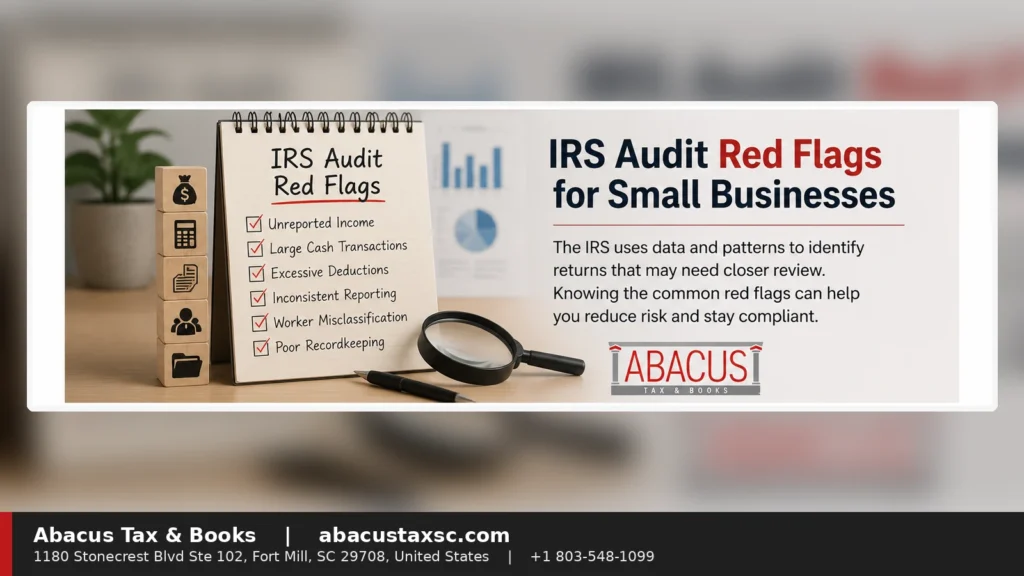
Poor Recordkeeping and Missing Documentation
Accurate records are one of the strongest protections a small business can have when tax questions arise.
Business owners should be able to support the income, expenses, deductions, and other amounts reported on their returns.
Useful records can include:
- Receipts
- Invoices
- Bank statements
- Credit card statements
- Payroll reports
- Mileage records
- Contracts
- Vendor records
- Tax forms
- Accounting reports
- Proof of payment
A bank statement alone may not always explain why a particular expense qualified as a business expense.
For example, a credit card charge from a hotel might relate to legitimate business travel, but additional documentation could help establish the business purpose of the trip.
Maintaining records throughout the year is much easier than trying to reconstruct them after receiving an IRS notice.
Businesses should establish a consistent system for storing financial and tax documentation and follow applicable record-retention requirements.
How Small Businesses Can Reduce Audit Risks
No business can completely eliminate the possibility of an audit.
However, small business owners can reduce avoidable tax reporting problems by improving their financial processes.
Maintain accurate bookkeeping
Keep revenue, expenses, assets, liabilities, and owner transactions properly recorded throughout the year.
Separate business and personal finances
Use dedicated business bank accounts and credit cards whenever practical.
Report all income
Do not rely solely on tax documents from customers or payment processors. Compare them with internal accounting records.
Keep supporting documentation
Maintain receipts, invoices, contracts, payroll records, and other documentation that supports reported amounts.
Reconcile accounts regularly
Bank accounts, credit cards, payroll accounts, and bookkeeping records should be reconciled consistently.
Review unusual transactions
Large deductions, significant year-over-year changes, and unusual transactions should be reviewed before the tax return is filed.
Classify workers carefully
Make sure employee and contractor classifications reflect applicable requirements.
Review the return before filing
Business owners should understand the major numbers on their tax return and be able to connect them to their financial records.
These practices do more than reduce tax reporting risk. They also give owners more reliable financial information for managing the business.
What to Do If Your Business Receives an IRS Notice
Receiving an IRS notice does not automatically mean your business is being audited or accused of wrongdoing.
The IRS sends notices for many reasons, including requests for information, reporting discrepancies, payment issues, account changes, and other administrative matters.
If your business receives a notice:
- Read the entire notice carefully. Identify what the IRS is requesting and the tax period involved.
- Check the response deadline. Some notices require action within a specific period.
- Compare the notice with your records. Review the tax return, bookkeeping records, payments, and supporting documents related to the issue.
- Do not ignore the notice. Even if you believe the IRS is incorrect, failing to respond can allow the issue to progress.
- Avoid sending unnecessary information. Provide the information required to address the specific issue.
- Keep copies of correspondence. Maintain organized records of notices, responses, supporting documents, and communications.
- Consider professional assistance. More complicated tax notices may require help from a qualified tax professional.
Some IRS matters can be resolved by correcting a simple discrepancy or providing documentation. Others may involve more detailed examination.
The appropriate response depends on the specific notice and the circumstances of the business.
How Tax Consulting Can Support Accurate Reporting
Tax consulting can help small business owners understand how financial decisions connect with tax reporting requirements.
Rather than addressing tax issues only when a return is due, ongoing tax planning and financial review can help identify potential problems earlier.
Professional support may help businesses:
- Review financial records for inconsistencies
- Understand business deductions
- Prepare for estimated tax obligations
- Review business structure considerations
- Identify missing documentation
- Reconcile tax and accounting records
- Review significant transactions
- Address questions about worker classification
- Prepare for year-end tax reporting
At Abacus Tax & Books, we work with small business owners who want clearer financial records and more organized tax preparation.
Accurate reporting starts long before a tax return is filed. Consistent bookkeeping, complete documentation, and regular financial reviews can make tax preparation more efficient and help business owners understand the numbers they are reporting.
Tax requirements vary based on business structure, location, transactions, and other circumstances. Business owners with specific concerns should consult a qualified tax professional who can review their individual situation.
FAQs
What usually triggers an IRS audit for a small business?
There is no single event that automatically causes an audit. Reporting inconsistencies, unreported income, unusual deductions, repeated losses, worker classification issues, and discrepancies between tax documents and reported income may increase the likelihood of additional scrutiny.
Does a large business deduction automatically trigger an audit?
No. Businesses can have legitimate large expenses. The important issue is whether deductions comply with applicable tax rules and can be supported with appropriate documentation.
Will reporting a business loss cause an IRS audit?
Not necessarily. Many businesses experience losses, particularly during startup periods or difficult economic conditions. Repeated or substantial losses may receive additional scrutiny depending on the circumstances.
Can the IRS see income reported through payment platforms?
Certain payment processors, financial institutions, customers, and other entities may report information to the IRS depending on applicable reporting requirements. Businesses should maintain their own complete income records rather than relying only on informational tax forms.
Is using a personal credit card for business expenses a problem?
Using a personal card does not automatically make a legitimate business expense nondeductible, but mixing personal and business spending can make recordkeeping much more difficult. Separate business accounts generally make expenses easier to document and reconcile.
What records should a small business keep for taxes?
Businesses commonly maintain receipts, invoices, bank statements, credit card statements, payroll records, contracts, mileage logs, accounting reports, and tax documents. The appropriate records and retention periods depend on the transaction and applicable requirements.
Does receiving an IRS notice mean my business is being audited?
No. IRS notices can relate to many issues, such as missing information, account changes, payment questions, or differences between reported amounts. The notice itself should explain why the IRS contacted the business and what action, if any, is required.
How can bookkeeping help reduce tax reporting problems?
Accurate bookkeeping creates an organized record of income, expenses, assets, liabilities, payroll activity, and other transactions. Regular reconciliation can identify discrepancies before they appear on a tax return.
Keep Your Business Tax Records Organized With Abacus Tax & Books
Avoiding tax problems is not about trying to make a business tax return look a certain way. It is about making sure the return accurately reflects what actually happened in the business and that the numbers can be supported.
At Abacus Tax & Books, we help small businesses maintain organized bookkeeping, prepare reliable financial records, and approach tax reporting with greater confidence. Regular financial reviews can uncover missing transactions, unusual account balances, classification problems, and documentation gaps before they create larger issues.
If you have questions about deductions, income reporting, business tax planning, or financial recordkeeping, professional guidance can help you understand which requirements apply to your specific situation.