
Startup Accounting Checklist Before Launch
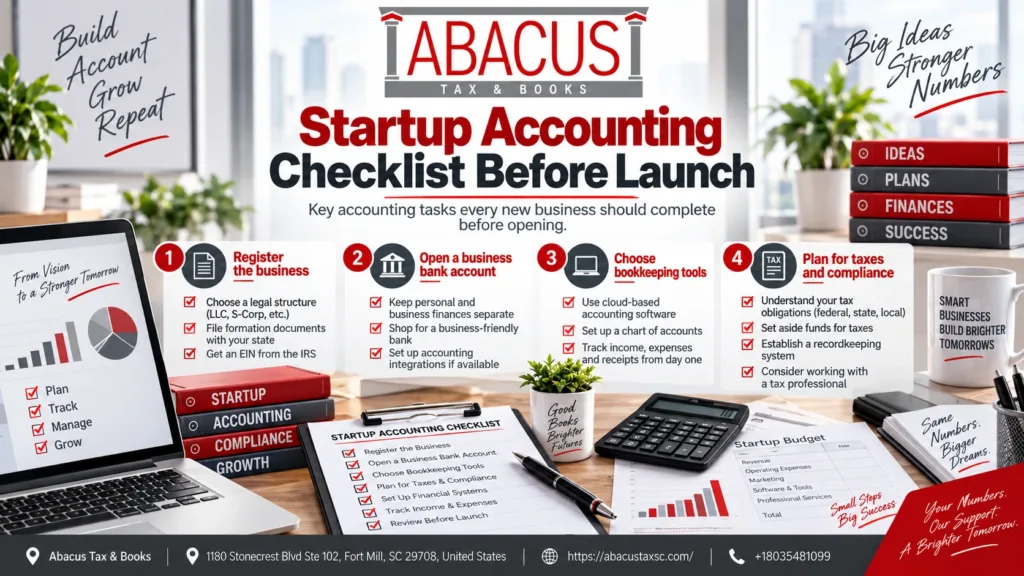
Before launching a new business, owners should separate business and personal finances, choose an appropriate business structure, establish an accounting system, understand tax obligations, organize financial records, and create a basic budget and cash flow plan. Completing these steps early can prevent accounting problems from becoming expensive distractions later.
At Abacus Tax & Books, we encourage startup owners to build their financial systems before sales begin. Requirements vary based on business type, location, employees, and industry, so professional accounting, tax, or legal guidance may be necessary for specific obligations.
Why Accounting Setup Matters Before Launch
It is easy to focus almost entirely on the product, service, website, branding, equipment, and customers when starting a business.
Accounting often gets pushed aside until transactions begin piling up.
That can create problems quickly.
Without a financial system in place, a new owner may struggle to determine:
- How much money the business is actually making
- Which expenses are deductible or business-related
- How much cash is available
- Which bills are approaching
- What taxes may need to be paid
- How much customers owe
- Whether the company is operating within budget
Good accounting setup creates a foundation before the business becomes busy.
It also makes bookkeeping easier because transactions begin entering an organized system from day one rather than requiring months of cleanup later.
Choose the Right Business Structure
One of the earliest decisions is determining how the business will be legally organized.
Common structures include:
- Sole proprietorship
- Partnership
- Limited liability company, or LLC
- Corporation
- Certain tax classifications available to qualifying businesses
The appropriate option depends on factors such as ownership, liability concerns, tax considerations, growth plans, and administrative requirements.
Business structure can affect how income is reported, how owners are paid, which tax forms may be required, and what records need to be maintained.
Do Not Choose Based Only on What Other Businesses Use
A friend operating an LLC does not necessarily mean an LLC is automatically the right choice for every startup.
Likewise, forming a corporation simply because the business expects to grow may create obligations the owner does not fully understand.
Before deciding, consider:
- Number of owners
- Expected revenue
- Liability exposure
- Plans to hire employees
- How profits will be distributed
- Potential investors
- Long-term growth plans
- Federal and state tax implications
An attorney or qualified tax professional can help explain how different structures may affect your specific situation.
Open a Separate Business Bank Account
Business and personal finances should be separated as early as possible.
Using a personal checking account for customer payments, subscriptions, equipment purchases, advertising, and business expenses makes bookkeeping more difficult.
A dedicated business bank account creates a cleaner financial record.
Use it for business activities such as:
- Receiving customer payments
- Paying vendors
- Purchasing supplies
- Paying business expenses
- Making tax payments
- Receiving financing
- Paying employees or contractors
A separate business credit card may also simplify expense tracking.
Avoid Mixing Personal and Business Spending
Commingling transactions creates unnecessary confusion.
If the business buys equipment with a personal card or pays a personal expense from the company account, the transaction may require additional bookkeeping adjustments.
Occasional situations can happen, particularly during startup. However, establishing clear separation from the beginning makes financial records much easier to maintain.
Set Up an Accounting System
Do not wait until tax season to decide how business transactions will be recorded.
Choose an accounting system before regular activity begins.
Depending on the business, accounting software may track:
- Income
- Expenses
- Bank transactions
- Customer invoices
- Vendor bills
- Accounts receivable
- Accounts payable
- Payroll-related activity
- Financial reports
The best system is not necessarily the one with the most features.
Choose software appropriate for your business size, transaction volume, industry, and bookkeeping needs.
Connect Financial Accounts Carefully
Many accounting platforms can connect with bank and credit card accounts.
This can make transaction entry more efficient, but automatic imports do not eliminate the need for accurate categorization and reconciliation.
Transactions still need to be reviewed.
Accounting software is a tool. It does not automatically guarantee accurate books.
Create a Chart of Accounts
The chart of accounts is the organizational framework for a company’s bookkeeping.
It divides financial activity into categories such as:
Assets
Examples include:
- Cash
- Accounts receivable
- Equipment
- Inventory
Liabilities
Examples may include:
- Credit card balances
- Loans
- Accounts payable
- Certain tax obligations
Equity
These accounts track the owners’ financial interest in the business.
Revenue
Revenue categories may separate different products, services, or income streams.
Expenses
Examples include:
- Advertising
- Insurance
- Rent
- Supplies
- Software
- Professional services
- Payroll expenses
- Vehicle expenses
The chart should provide useful information without becoming unnecessarily complicated.
Too few categories can make financial reports vague.
Too many can make bookkeeping cumbersome and inconsistent.
Starting with a sensible structure helps financial statements become more useful as the company grows.
Understand Business Licenses and Registrations
Accounting setup does not happen separately from business registration requirements.
Before launching, determine which registrations, permits, or licenses apply to the company.
Requirements vary significantly depending on:
- State
- County
- City
- Industry
- Business activity
- Products or services
- Physical location
- Professional licensing requirements
A business operating from home may face different requirements than one running a retail storefront.
Contractors, food businesses, professional services, online sellers, and other industries may also have specific obligations.
Keep Registration Records Organized
Store copies of documents such as:
- Formation paperwork
- Federal identification documents
- State registrations
- Local business licenses
- Permits
- Professional licenses
- Insurance documents
Create a calendar for renewal dates when necessary.
Do not assume that forming an LLC or registering a business name automatically satisfies every licensing requirement.
Identify Your Tax Responsibilities
Taxes are one of the most important areas to address before the business starts earning money.
Your obligations depend on the business structure, location, industry, ownership, employees, and type of sales.
Possible tax responsibilities may include:
- Federal income tax
- State income tax
- Estimated tax payments
- Payroll taxes
- Sales and use taxes
- Local taxes
- Business-specific taxes or fees
Not every tax applies to every business.
This is why startup owners should identify their specific obligations rather than relying on general online checklists.
Understand When Payments May Be Due
A common startup mistake is assuming all taxes are handled through one annual tax return.
Some businesses may need to make payments or submit filings throughout the year.
Missing a filing because the business owner did not know it existed can create avoidable penalties or administrative problems.
A tax professional can help identify applicable registrations, filing requirements, and payment schedules.
Set Money Aside
Tax money should not be treated as available operating cash.
Depending on your situation, consider establishing a process for regularly reserving funds for upcoming tax obligations.
Set Up Payroll and Contractor Tracking
If the business will hire workers, payroll procedures should be established before the first payday.
Payroll involves more than transferring money to an employee.
Businesses may need to address:
- Worker classification
- Payroll withholding
- Employer payroll taxes
- Payroll registrations
- Wage records
- Pay schedules
- Payroll tax filings
- Year-end reporting
Payroll errors can become costly, so avoid improvising the process after employees have already started working.
Employees and Independent Contractors Are Not Interchangeable
Businesses should also be careful about worker classification.
Simply calling someone an independent contractor does not necessarily make that classification appropriate.
Classification depends on the actual working relationship and applicable rules.
If you are uncertain, seek professional guidance before establishing payment arrangements.
Track Contractor Payments
Even when workers are legitimately classified as independent contractors, payments need to be recorded accurately.
Maintain appropriate information and supporting records from the beginning rather than trying to reconstruct payments at year-end.
Create a Budget and Cash Flow Plan
A startup budget answers an important question:
How much money will the business need before it can support itself?
Begin by estimating startup expenses.
These may include:
- Formation fees
- Licenses
- Equipment
- Website development
- Branding
- Insurance
- Professional services
- Initial inventory
- Deposits
- Furniture
- Technology
- Marketing
Then estimate ongoing monthly costs.
Common expenses include:
- Rent
- Payroll
- Software
- Advertising
- Insurance
- Utilities
- Supplies
- Loan payments
- Professional services
Be Conservative About Revenue
Startup revenue rarely arrives exactly as forecast.
It may take longer to build a customer base, collect invoices, or reach consistent sales.
Consider creating several scenarios:
- Conservative
- Expected
- Strong growth
This helps show how long available cash might last under different conditions.
Understand Cash Flow
Profitability and cash flow are related but different.
A business can generate sales without immediately receiving the cash.
For example, if customers have 30 days to pay invoices, the company may still need to cover payroll and other expenses before those payments arrive.
A cash flow plan helps anticipate these timing gaps.
Organize Receipts and Financial Records
Strong recordkeeping should begin with the first business transaction.
Do not rely on a box of paper receipts and memory at the end of the year.
Create a system for storing documents such as:
- Receipts
- Vendor invoices
- Customer invoices
- Bank statements
- Credit card statements
- Contracts
- Loan documents
- Payroll records
- Tax documents
- Equipment purchases
- Insurance records
Digital storage can make recordkeeping easier, particularly if documents are attached directly to accounting transactions.
Create Consistent Habits
Choose a regular schedule for financial administration.
For example, each week you might:
- Upload receipts
- Review transactions
- Send invoices
- Follow up on overdue balances
- Enter vendor bills
Then each month:
- Reconcile bank accounts
- Reconcile credit cards
- Review financial reports
- Check cash flow
- Review outstanding invoices
- Prepare for upcoming financial obligations
Consistent maintenance is much easier than months of bookkeeping cleanup.
Common Startup Accounting Mistakes to Avoid
New businesses often make similar financial mistakes.
Mixing Business and Personal Transactions
This makes accounting harder and can create confusion about which expenses belong to the company.
Waiting Too Long to Start Bookkeeping
Trying to reconstruct months of transactions after the fact wastes time and increases the likelihood of mistakes.
Not Reconciling Accounts
Accounting records should be compared with actual bank and credit card activity regularly.
Assuming Accounting Software Handles Everything
Software can automate certain processes, but transactions still need proper categorization, review, and reconciliation.
Forgetting About Taxes
Tax obligations should be considered throughout the year rather than shortly before a filing deadline.
Failing to Track Receivables
Revenue on an invoice does not help cash flow until the customer actually pays.
Overestimating Early Revenue
New businesses frequently take longer to gain consistent customers than expected.
Ignoring Financial Reports
Reports are only useful if owners review and understand them.
Poor Documentation
Missing receipts, contracts, and invoices can make accounting and tax preparation unnecessarily difficult.
Starting with disciplined financial habits can prevent these issues from growing as the company expands.
How Accounting Services Support New Businesses
Starting a business involves many financial decisions, and owners do not always know which accounting questions they should be asking.
Professional accounting and bookkeeping support can help establish systems before financial activity becomes complicated.
At Abacus Tax & Books, accounting support can help new business owners organize areas such as:
- Bookkeeping setup
- Chart of accounts
- Transaction categorization
- Account reconciliation
- Financial reporting
- Payroll-related recordkeeping
- Tax preparation planning
- Budgeting information
- Cash flow tracking
- Year-end organization
The goal is not simply to keep records for tax season.
Accurate books give business owners information they can use throughout the year.
Financial reports can help show whether revenue is meeting expectations, which expenses are increasing, how much customers owe, and whether the business is operating according to plan.
Starting with organized accounting is usually easier than repairing a disorganized system after the business has grown.
Start Your Business With Organized Financial Records
A strong startup accounting checklist begins before the first customer payment arrives.
Choose the appropriate business structure, separate business finances, establish an accounting system, understand your tax responsibilities, prepare payroll procedures if necessary, create a budget, and organize financial documents from day one.
You do not need to understand every accounting or tax rule yourself.
At Abacus Tax & Books, we help business owners establish organized financial records and better understand the numbers behind their companies. Because tax, registration, payroll, and accounting requirements can vary by business type and location, getting professional guidance early can also help prevent costly mistakes.
If you are preparing to launch a business, contact Abacus Tax & Books to discuss bookkeeping, accounting, and tax support that can help you begin with a stronger financial foundation.
FAQs
What accounting should I set up before starting a business?
At minimum, establish a separate business bank account, choose an accounting system, create an appropriate chart of accounts, develop a recordkeeping process, identify applicable taxes, and prepare a budget. Businesses with employees or contractors should also establish appropriate payroll and payment tracking procedures.
Do I need accounting software before I launch?
Using accounting software from the beginning can make financial tracking significantly easier. It allows transactions to be categorized consistently, accounts to be reconciled, invoices to be tracked, and financial reports to be generated without rebuilding records later.
When should a startup hire a bookkeeper or accountant?
There is no single required stage. Some owners seek help before launch to establish their accounting structure, while others need support once transaction volume increases. Getting assistance early can be especially useful when the business has employees, inventory, multiple owners, complicated tax obligations, or significant startup expenses.
Should I open a business bank account before making startup purchases?
When possible, establishing a separate business account early creates cleaner records. If legitimate business expenses are paid personally during the startup period, maintain clear documentation and ask your accounting professional how they should be recorded.
How much money should a startup reserve for taxes?
There is no universal percentage that applies to every startup. The appropriate amount depends on factors such as business structure, profitability, location, owner circumstances, payroll, and applicable taxes. A tax professional can help determine an appropriate payment and reserve strategy.
What financial reports should a startup review?
Common reports include the profit and loss statement, balance sheet, cash flow information, accounts receivable reports, and accounts payable reports. The most useful reports depend on how the business operates, but reviewing them regularly can help owners understand profitability, cash availability, expenses, and outstanding obligations.