
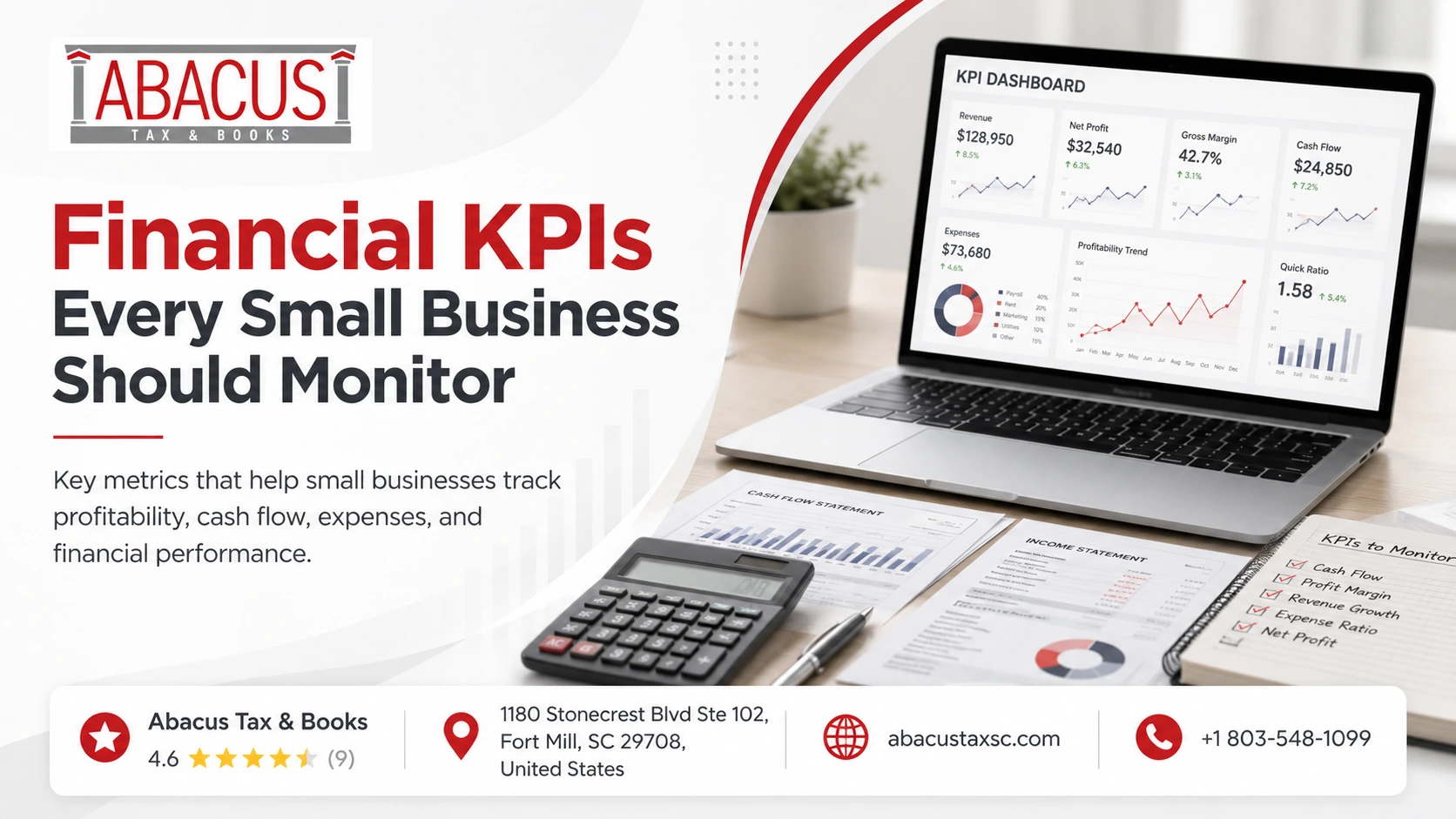
Financial KPIs Every Small Business Should Monitor
Running a small business involves more than watching the balance in a bank account. Revenue may be increasing while expenses rise even faster, or a company may appear profitable on paper while struggling to maintain enough cash for upcoming bills.
Financial key performance indicators, or KPIs, help turn bookkeeping data into information business owners can use. By monitoring a focused set of financial KPIs for small business, owners can identify trends in profitability, cash flow, collections, and operating costs before making important decisions.
At Abacus Tax & Books, we believe financial information becomes most valuable when business owners can understand what the numbers are telling them, not simply record them.
What Are Financial KPIs?
Financial KPIs are measurable indicators used to evaluate specific areas of a company’s financial performance.
Revenue, profit margins, cash flow, accounts receivable, and operating expenses can all provide useful performance information. However, not every number in your accounting system needs to become a KPI.
A useful KPI should help answer a meaningful business question. For example: Is revenue growing? Are costs increasing faster than sales? Are customers paying invoices promptly? Does the business have enough cash to meet its obligations?
The most useful KPIs vary by industry, business model, size, and stage of growth.
Why Should Small Businesses Track Financial KPIs?
KPIs make it easier to identify financial trends instead of evaluating the business based on individual transactions or intuition.
Consistent monitoring can help owners:
- Recognize changes in profitability
- Monitor cash availability
- Identify rising expenses
- Track customer payments
- Compare performance over time
- Build more realistic budgets
- Make better-informed business decisions
The goal is not to collect as many metrics as possible. A small group of relevant KPIs can often provide more useful insight than a complicated dashboard filled with numbers that do not influence decisions.
What Financial KPIs Should Every Small Business Monitor?
There is no universal list that every company must follow. However, several indicators are useful starting points for many small businesses.
These include:
- Revenue and revenue growth
- Gross profit margin
- Net profit margin
- Cash flow
- Accounts receivable
- Accounts payable
- Operating expenses
- Working capital
- Debt levels
Businesses may add industry-specific KPIs based on their operations.
A service business, retailer, contractor, and professional practice can have very different cost structures and revenue cycles. Instead of comparing your company against an arbitrary universal benchmark, focus on relevant trends and meaningful comparisons.
How Should You Track Revenue Growth?
Revenue growth measures how sales change from one period to another.
For example, a business might compare monthly revenue with the previous month or compare the current quarter with the same quarter from the previous year.
Tracking revenue over time can help identify growth, seasonal changes, or periods of declining sales.
More Revenue Does Not Always Mean More Profit
Revenue growth can look positive while profitability is declining.
Suppose sales increase by 15%, but labor, materials, marketing, and other operating costs rise by 25%. The company is generating more revenue, but the additional sales may not be producing stronger profits.
That is why revenue should be considered alongside margins and expenses rather than viewed in isolation.
What Do Gross Profit Margin and Net Profit Margin Tell You?
Profit margins help business owners understand how much of their revenue remains after certain costs.
Gross Profit Margin
Gross profit margin looks at revenue after accounting for the direct costs associated with producing goods or delivering services.
It can help owners understand whether pricing and direct costs are supporting a sustainable level of gross profit.
Net Profit Margin
Net profit margin goes further by considering the broader expenses of running the business.
It shows how much of the company’s revenue ultimately remains as profit after applicable business expenses are considered.
Monitoring both metrics can reveal different issues. A declining gross margin may point toward changes in direct costs or pricing, while changes in net margin may reflect broader operating expenses.
Why Is Cash Flow an Important Business KPI?
Profit and cash are not the same thing.
A business can report a profit while still experiencing a cash shortage. For example, revenue may have been recorded from customer invoices even though those customers have not paid yet.
Meanwhile, payroll, rent, vendors, loan payments, and other obligations may require actual cash.
Monitoring cash flow helps owners understand how money is moving into and out of the business and whether available cash is keeping pace with obligations.
Look Beyond the Current Bank Balance
A healthy bank balance today does not necessarily mean the business will have sufficient cash next month.
Upcoming bills, unpaid customer invoices, seasonal changes, equipment purchases, and other obligations can affect future cash needs.
This is one reason accurate [Financial Reports] can be valuable. They provide much of the underlying information owners need to understand financial performance beyond the current account balance.
What Can Accounts Receivable KPIs Tell You?
Accounts receivable represents money customers owe the business for products or services already provided on credit.
For businesses that invoice customers, monitoring receivables can reveal how efficiently sales are being converted into actual cash.
Useful questions include:
- How much money is currently outstanding?
- How long are invoices taking to be paid?
- Are overdue balances increasing?
- Are particular customers consistently paying late?
A growing accounts receivable balance is not automatically negative if sales are increasing. However, slow collections can create cash flow pressure even when reported revenue appears strong.
Which Expense and Operating Efficiency Metrics Matter?
Operating expenses should be monitored in relation to business activity rather than simply viewed as individual costs.
Business owners can track major expenses over time and compare how quickly costs are changing relative to revenue.
For example, if revenue grows modestly while administrative or operating expenses increase significantly, it may be worth understanding why.
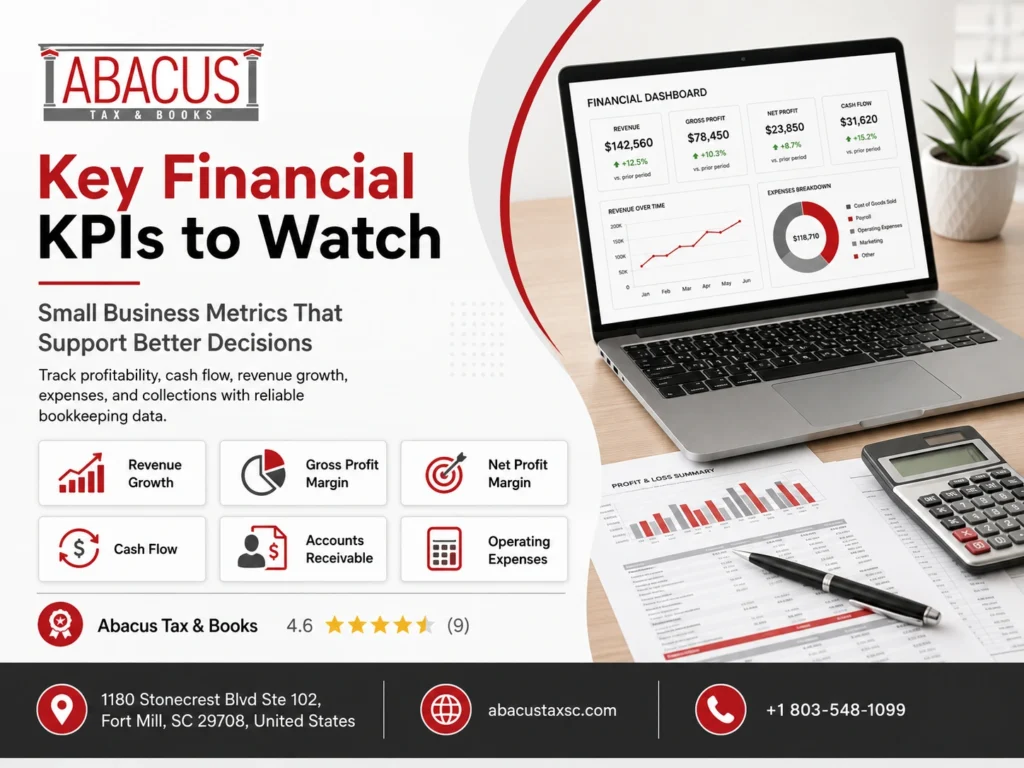
Depending on the business, useful expense-related KPIs might focus on payroll, marketing, occupancy, software, materials, or other significant operating costs.
Additional indicators such as working capital, current ratio, break-even point, or debt levels may also provide useful insight. Which metrics matter most depends on how the company operates and what decisions management needs to make.
How Do You Build a Simple Financial KPI Dashboard?
A useful dashboard does not need dozens of charts.
Start with a small number of KPIs that answer your most important financial questions. For many businesses, that might include revenue growth, gross margin, net margin, cash flow, receivables, and one or two significant expense measures.
Focus on Trends
A KPI becomes more useful when you can compare it over time.
Your dashboard might display:
- Current result
- Previous period result
- Year-to-date result
- Change from the prior period
- Relevant internal target
Avoid adding metrics simply because they are easy to calculate. Every KPI should help you understand performance or support a business decision.
Reliable dashboards also depend on accurate underlying records. Consistent [Bookkeeping] helps ensure the transactions feeding your KPIs are properly recorded and categorized.
How Often Should Small Businesses Review Their KPIs?
Review frequency depends on the metric and how quickly conditions change within the business.
Cash availability may need frequent attention, particularly in a company with tight cash flow. Sales or receivables might be reviewed weekly in some businesses.
Broader profitability and expense trends may make more sense to review monthly or quarterly.
The important point is consistency.
Reviewing KPIs on a predictable schedule makes it easier to identify trends and investigate unusual changes instead of discovering problems months later.
When Can a Bookkeeper Help With Financial KPI Tracking?
A KPI is only as useful as the financial information behind it.
If transactions are missing, accounts are not reconciled, or income and expenses are categorized inconsistently, KPI calculations may provide a misleading picture.
A bookkeeper can help maintain accurate records, reconcile accounts, organize transactions, and produce consistent financial information that supports KPI monitoring.
For businesses in Fort Mill, professional bookkeeping support can also make it easier to establish a regular financial review process rather than waiting until tax season to understand business performance.
At Abacus Tax & Books, we help business owners build cleaner financial records so they can use their numbers to understand where their businesses stand and where attention may be needed.
FAQs
What is a financial KPI?
A financial KPI is a measurable indicator used to monitor a specific aspect of financial performance, such as profitability, revenue growth, cash flow, or collections.
Which financial KPIs matter most for a small business?
Revenue, profit margins, cash flow, accounts receivable, and operating expenses are useful starting points for many businesses. The right combination depends on the company’s industry, business model, and goals.
How many KPIs should a small business track?
There is no required number. A focused dashboard containing a small set of meaningful KPIs is often more useful than tracking many metrics that do not support decisions.
How often should financial KPIs be reviewed?
Some metrics may require weekly monitoring, while others are better reviewed monthly or quarterly. Review frequency should reflect how quickly the metric changes and how important it is to business decisions.
Is profit the same as cash flow?
No. A business can report profit without having the same amount available in cash because revenue and expenses may be recognized at different times from actual cash receipts and payments.
Where does KPI data come from?
Much of the information comes from bookkeeping records and financial reports, including income statements, balance sheets, accounts receivable records, and other accounting data.
Are good KPI benchmarks the same for every industry?
No. Appropriate results vary widely by industry, business model, company size, pricing structure, and growth stage. Owners should be cautious about applying generic benchmarks without context.
When should I get bookkeeping help with KPI tracking?
Professional support may be useful when records are inconsistent, accounts are not regularly reconciled, financial reports are difficult to interpret, or you need reliable information for ongoing performance monitoring.
Turn Your Financial Numbers Into Useful Business Insight
Financial KPIs are most valuable when they help you recognize trends and make better-informed decisions. Rather than waiting until year-end to evaluate performance, consistent monitoring can provide an ongoing view of profitability, cash flow, collections, and operating costs.
At Abacus Tax & Books, we help small-business owners maintain the organized bookkeeping and financial information needed to understand those numbers with greater clarity. If you want a clearer view of how your business is performing, our team can help you establish consistent records and reporting that make meaningful KPI tracking easier.