
Business Mileage Tracking Guide
Business mileage tracking means keeping a clear record of miles driven for legitimate business purposes so those trips can be properly documented at tax time. A reliable mileage log should generally identify when the trip occurred, where you went, how many miles you drove, and the business reason for the travel.
Good mileage records do more than help calculate a potential vehicle deduction. They create documentation that supports your tax return, separates business driving from personal travel, and makes year-end bookkeeping easier. At Abacus Tax & Books, we recommend treating mileage tracking as an ongoing recordkeeping task rather than trying to reconstruct an entire year of driving when tax season arrives.
What Counts as Business Mileage?
Business mileage generally involves driving that is directly connected to operating your trade or business.
Depending on the circumstances, qualifying trips could include driving:
- From your office to a client’s location
- Between customer appointments
- To meet with a supplier or vendor
- To purchase business supplies
- Between multiple business locations
- To the bank for a business-related transaction
- To a professional conference or business meeting
- To a temporary work location when the applicable tax requirements are met
- To pick up or deliver business materials
The important distinction is the business purpose of the trip.
If a contractor leaves a business location to visit a customer’s property, for example, that mileage may be business-related. If a consultant drives from one client meeting directly to another, that travel may also qualify.
Trips that contain both business and personal elements require more attention. Business owners should document the business portion rather than assuming an entire day’s driving is deductible.
IRS guidance distinguishes deductible business transportation from personal commuting, so the starting point and purpose of each trip can matter.
What Mileage Records Should You Keep?
Mileage records should provide enough information to establish that the driving actually occurred and was connected to the business.
A good recordkeeping system generally includes:
- Date of travel
- Starting location
- Destination
- Business purpose
- Business miles driven
- Vehicle used
- Total annual mileage when relevant
- Supporting documentation where appropriate
Supporting records might include appointment calendars, customer invoices, delivery records, receipts, or meeting schedules.
The IRS emphasizes keeping records at or near the time an expense or business use occurs. A record prepared regularly tends to carry more weight than one reconstructed months later from memory. The IRS also recognizes computer-based records as acceptable when they provide adequate documentation.
That means business owners do not necessarily need a paper notebook in the glove compartment. A spreadsheet, accounting system, or mileage tracking application can work as long as the records are accurate and complete.
How Do IRS Mileage Rules Work?
Business owners generally have two methods for calculating eligible vehicle costs: the standard mileage method or the actual expense method, subject to the rules that apply to the vehicle and taxpayer.
With the standard mileage method, qualifying business miles are multiplied by the applicable IRS mileage rate for that period.
With the actual expense method, a business calculates the deductible business portion of qualifying vehicle expenses, which can potentially include items such as fuel, insurance, repairs, depreciation, lease payments, registration costs, and other eligible expenses.
IRS Publication 583 explains that when a vehicle is used for both business and personal purposes, expenses generally need to be divided between those uses.
The IRS standard mileage rate can change from one tax year to another and, in some circumstances, can even be revised during a year. Business owners should therefore use the rate that applies to the specific tax period rather than relying on an old number saved in a spreadsheet or bookkeeping template.
There are also rules governing when taxpayers may choose or switch between the standard mileage and actual expense methods. For example, the treatment can differ depending on whether a vehicle is owned or leased.
For that reason, tracking business mileage remains useful even if you are not sure which vehicle expense method will ultimately be used.
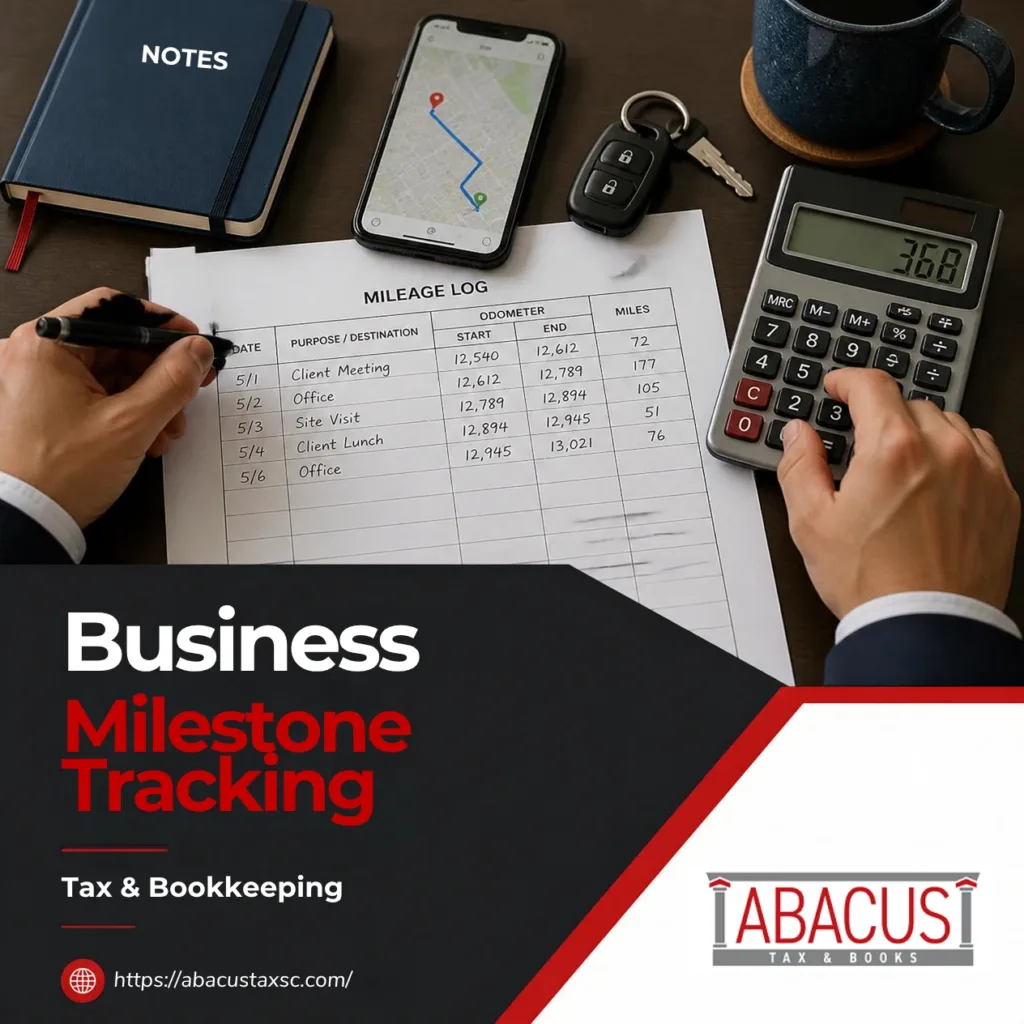
What Information Should Be Included in a Mileage Log?
A mileage log should allow someone reviewing your records to understand the trip without having to guess why it was business-related.
A practical entry could include:
Date: September 14
Starting location: Business office
Destination: Customer location
Purpose: On-site customer consultation
Business miles: 18 miles
The IRS generally expects taxpayers to be able to establish the date, destination, mileage, and business purpose associated with vehicle use. Records should be maintained in an account book, diary, log, trip sheet, computer record, or similar system.
Avoid descriptions that are too vague.
Entries such as “business,” “work trip,” or “meeting” may provide less useful documentation than:
- Client consultation
- Supplier pickup
- Property inspection
- Customer delivery
- Meeting with accountant
- Equipment purchase
- Site estimate
You do not need to write a paragraph about every trip. The goal is simply to create enough detail to establish why the mileage was connected to the business.
It can also be useful to record beginning and ending odometer readings periodically, particularly when you need to determine business versus personal vehicle use.
Can You Use a Mileage Tracking App?
Yes. Mileage tracking apps can make maintaining records easier, particularly for business owners who drive frequently.
Depending on the app, features may include:
- Automatic trip detection
- GPS-based mileage tracking
- Business and personal trip classification
- Notes for business purposes
- Monthly mileage summaries
- Annual reports
- Multiple vehicle tracking
- Exportable records
- Accounting software integrations
Automatic tracking can be useful because it reduces the risk of forgetting a trip.
However, automation does not eliminate the need to review records.
An app may recognize that you drove 14 miles, but it may not know whether that trip was for a customer appointment, grocery shopping, or a personal medical visit.
Business owners should regularly classify trips and add the appropriate business purpose.
Technology can simplify the documentation process, but the taxpayer remains responsible for maintaining records that adequately support claimed expenses.
Manual Mileage Logs vs. Tracking Apps
Both methods can work. The best choice depends on how often you drive for business and how consistently you maintain records.
Manual Mileage Logs
A manual mileage log may be suitable for someone who only makes a few business trips each month.
You could maintain records using:
- A notebook
- Printed mileage sheets
- A spreadsheet
- A bookkeeping worksheet
Manual tracking is simple and does not require another subscription or application.
The main disadvantage is that you must remember to record every trip.
Missing several weeks can quickly turn into reconstructing dozens of trips later.
Mileage Tracking Apps
Apps may be more practical for people who drive for business daily.
They can automatically record trips and provide a centralized record of driving activity.
The biggest advantage is convenience. The biggest risk is assuming that because trips were automatically captured, the records are complete.
Unclassified or incorrectly categorized trips should still be reviewed.
Whichever approach you choose, consistency matters more than having the most sophisticated system.
What Trips Usually Do Not Count as Business Mileage?
Not every trip related to your workday qualifies as deductible business mileage.
One of the most important distinctions involves commuting.
Travel between your home and your regular or main place of work is generally considered personal commuting rather than deductible business transportation.
For example, driving from home to your normal office in the morning and returning home at night generally does not become business mileage simply because you own the company.
Other personal driving generally should not be included either.
Examples might include:
- Driving to lunch for personal reasons
- Running household errands
- Driving children to school
- Personal shopping
- Recreational trips
- Regular home-to-work commuting
There are exceptions and special rules involving temporary work locations, home offices that qualify as a principal place of business, and travel between different work locations.
That is why simply labeling every mile driven during business hours as deductible can create problems.
When the classification of a trip is unclear, keep detailed records and discuss the circumstances with a qualified tax professional.
How Long Should You Keep Mileage Records?
Mileage records should generally be retained for as long as they may be needed to support information reported on a tax return.
In many ordinary situations, the IRS recommends maintaining records supporting income or deductions for at least three years after the applicable return is filed. However, longer retention periods can apply under certain circumstances.
Vehicle records may need to be kept longer when they relate to depreciation, vehicle basis, or other issues that affect multiple tax years.
That means business owners should not automatically delete mileage records immediately after filing a tax return.
A practical recordkeeping system might organize documentation by tax year and include:
- Mileage reports
- Vehicle expense records
- Fuel receipts where relevant
- Repair and maintenance invoices
- Insurance records
- Vehicle purchase or lease documents
- Parking and toll receipts
- Tax returns
Digital records should also be backed up.
If all of your mileage history exists only on a phone and that phone is lost, damaged, or replaced, reconstructing those records later could be difficult.
Common Business Mileage Tracking Mistakes
Mileage tracking is straightforward when it is done consistently. Problems usually arise when records are incomplete or created long after the trips occurred.
Waiting Until Tax Season
Trying to reconstruct 12 months of travel from memory can produce inaccurate mileage totals.
Calendars and bank statements may help, but contemporaneous records are much stronger.
Including Normal Commuting
Driving between home and a regular workplace generally does not become deductible simply because the taxpayer owns a business.
Forgetting the Business Purpose
Recording “27 miles” without identifying why those miles were driven leaves an important part of the documentation missing.
Estimating Mileage
Avoid simply estimating that you drove “around 10,000 business miles.”
IRS guidance states that deductible travel and transportation expenses generally need adequate substantiation rather than approximate amounts.
Mixing Business and Personal Trips
A vehicle used for both purposes requires careful separation.
Do not classify every mile as business simply because the vehicle is titled to the company or primarily used for work.
Ignoring Short Trips
Small errands add up.
Trips to purchase supplies, make deposits, deliver documents, or visit customers may represent significant mileage over an entire year.
Failing to Review App Data
Mileage applications can capture trips automatically, but business owners still need to classify and verify them.
Using the Wrong Year’s Mileage Rate
IRS mileage rates can change. Always confirm the rate applicable to the tax period being reported rather than copying a rate from a previous return.
How to Prepare Mileage Records for Tax Season
Preparing throughout the year is much easier than cleaning up mileage records in January or April.
Start by reviewing your mileage log for missing information.
Check that business trips include:
- Dates
- Destinations
- Mileage
- Business purposes
Then compare the mileage log with other business records.
Your calendar may show customer appointments that are missing from the mileage report. Invoices, delivery logs, and receipts may also help identify legitimate trips that were not classified correctly.
Next, separate business, commuting, and personal mileage.
If the vehicle is used for multiple purposes, make sure your records provide enough information to determine the business-use portion.
You should also gather other vehicle documentation that may be relevant, especially if actual vehicle expenses will be considered.
These records could include:
- Fuel purchases
- Repairs
- Maintenance
- Insurance
- Registration
- Lease payments
- Vehicle purchase documents
- Parking
- Tolls
Finally, provide your tax professional with organized records rather than only a single estimated mileage number.
At Abacus Tax & Books, having clear documentation allows us to better understand how a vehicle was used and identify questions before the return is prepared.
FAQs
What is the easiest way to track business mileage?
For people who drive frequently, an automatic mileage tracking app can be one of the easiest options. Those who only make occasional business trips may find a spreadsheet or written mileage log sufficient. The key is recording trips consistently.
Do I need receipts for every business mileage trip?
Mileage documentation primarily needs to establish details such as the mileage, date, destination, and business purpose. Other receipts and business records can help support the activity. Different documentation requirements can apply depending on the expense being claimed.
Can I estimate my business mileage at the end of the year?
Relying on a general estimate is risky. IRS guidance emphasizes adequate records and states that deductible travel or transportation expenses generally cannot simply be approximated. Records maintained at or near the time of travel are preferable.
Is driving from home to work business mileage?
Generally, driving between your home and regular workplace is considered personal commuting. Different rules may apply when a qualifying home office is your principal place of business or when traveling to certain temporary work locations.
Can I track mileage with my phone?
Yes. Electronic records can be acceptable, and mileage apps can help capture trips automatically. You should still review the information and document the business purpose of qualifying trips.
Does the IRS business mileage rate stay the same every year?
No. The IRS publishes standard mileage rates, and applicable rates can change between tax periods. Always confirm the rate that applies to the year, and potentially the portion of the year, being reported.
Make Business Mileage Easier to Manage
Business mileage may seem like a small bookkeeping detail, but missing records can mean missed deductions or additional questions when it is time to prepare a return. The easiest approach is to build mileage tracking into your normal business routine instead of trying to recreate months of driving later.
At Abacus Tax & Books, we help business owners maintain organized financial records and prepare for tax season with clearer documentation. That includes making sure business expenses are properly recorded and supporting information is available when needed.
Whether you use a mileage app, spreadsheet, or traditional logbook, review your records regularly, separate business and personal travel, and document why each qualifying trip was necessary.
If your current mileage records are incomplete or you are unsure how vehicle expenses should be handled for your business, our team can help you review your records and get better organized before tax season.