
Business Bank Reconciliation Explained
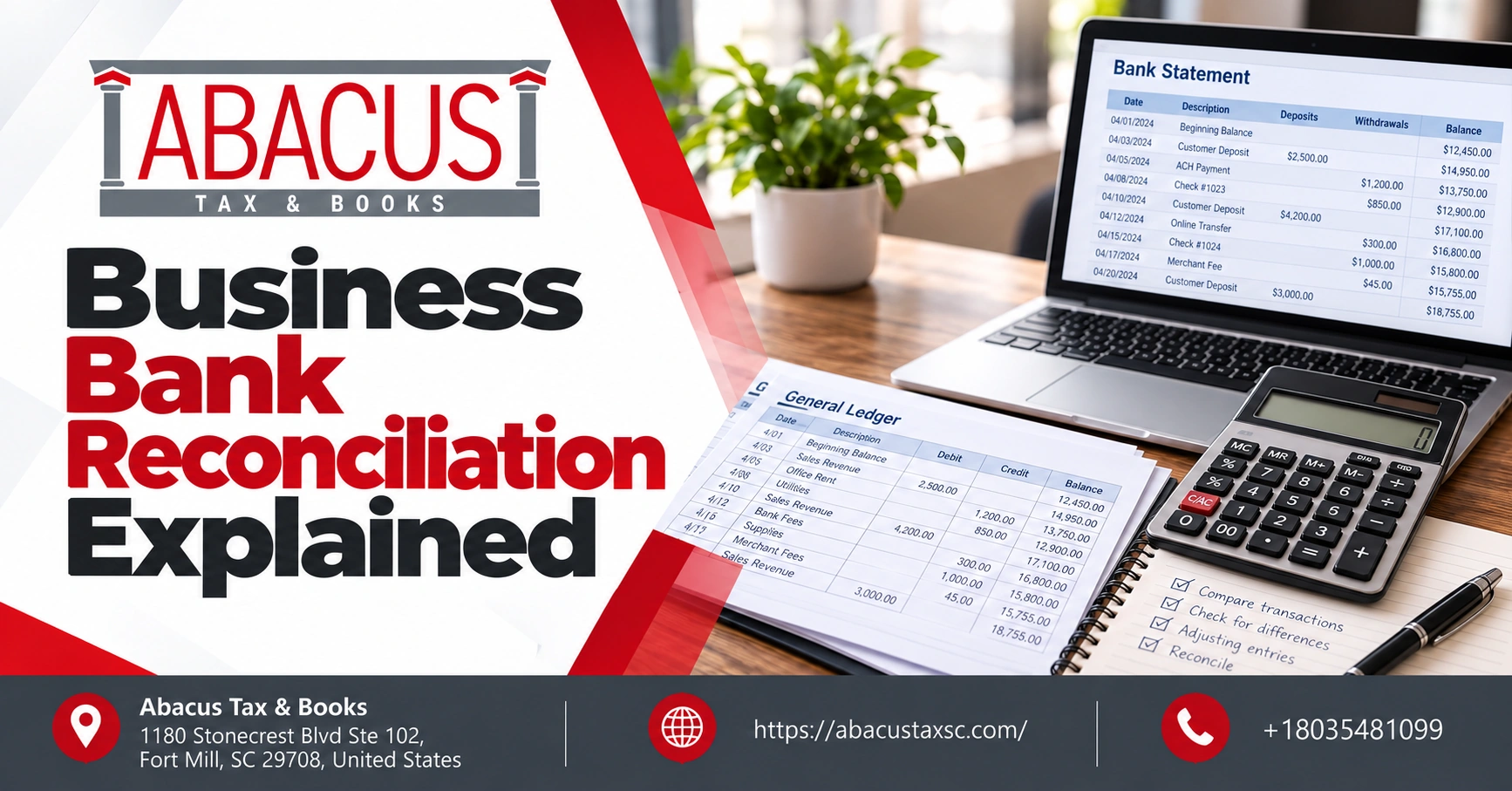
Business bank reconciliation is the process of comparing your company’s financial records with its bank statements to confirm that transactions are recorded accurately. It helps identify missing payments, duplicate entries, bank fees, and timing differences that could affect your reported cash balance.
Even when bookkeeping software automatically imports bank transactions, regular reconciliation remains necessary. At Abacus Tax & Books, we encourage business owners to review their accounts consistently so financial reports reflect actual activity, discrepancies are addressed promptly, and cash flow decisions are based on reliable information.
What Is Business Bank Reconciliation?
Business bank reconciliation is an accounting process that compares the transactions recorded in your bookkeeping system with those shown on your bank statement.
The objective is to explain any differences between the two balances and confirm that the records are complete and accurate.
For example, your accounting software might show $15,000 in a business checking account, while your bank statement shows $13,800.
This difference does not automatically mean something is wrong. A customer deposit may not have cleared, or a payment you recorded may still be outstanding.
Reconciliation helps determine whether the difference results from normal processing delays or an actual bookkeeping error.
The process generally involves three activities:
- Matching transactions: Confirming that recorded deposits and withdrawals appear on the bank statement.
- Identifying differences: Reviewing transactions that are missing, duplicated, incorrectly entered, or still pending.
- Making adjustments: Correcting bookkeeping records when necessary so the adjusted balances agree.
A completed reconciliation provides support for the cash balance reported in your accounting records.
Why Is Bank Reconciliation Important?
Accurate bookkeeping depends on knowing how much money your business has and whether its financial records reflect actual transactions.
Without regular reconciliation, even small errors can accumulate and create misleading financial reports.
Several important business activities depend on accurate bank balances.
Maintaining accurate financial records
Reconciliation helps confirm that deposits, withdrawals, transfers, and bank charges have been recorded correctly.
It also reduces the likelihood of carrying unresolved discrepancies into future accounting periods.
Identifying unexpected transactions
Reviewing bank activity can reveal unfamiliar withdrawals, unauthorized charges, or payments that require further investigation.
Although reconciliation alone cannot prevent fraud, it can help identify suspicious transactions earlier.
Supporting reliable financial reporting
Your balance sheet should reflect an accurate accounting cash balance.
Uncorrected errors may also affect income statements if revenue, expenses, or transfers have been recorded incorrectly.
Preparing for tax reporting
Accurate reconciliations support complete bookkeeping records, which can make tax preparation more organized.
They help reduce the risk of omitted income, duplicated expenses, and unsupported transactions.
Improving financial decisions
Business owners frequently rely on accounting reports when deciding whether to purchase equipment, pay vendors, or increase operating expenses.
Those decisions become more difficult when cash balances are unreliable.
How Does the Bank Reconciliation Process Work?
The bank reconciliation process follows a series of practical steps. Whether you use accounting software or maintain records manually, the underlying approach is similar.
Step 1: Collect your bank statement and bookkeeping records
Start with the bank statement for the period being reconciled.
Retrieve your general ledger or cash account transaction report for the same account and period.
Both documents should identify deposits, withdrawals, and balances.
Step 2: Compare deposits
Review the deposits recorded in your books and locate the corresponding entries on your bank statement.
Check that each amount matches and determine whether any deposits are missing.
A deposit recorded near the end of the month may not appear on the bank statement until the following month.
This is called a deposit in transit.
Step 3: Match withdrawals and payments
Compare recorded payments with the withdrawals shown by the bank.
These may include:
- Vendor payments
- Payroll withdrawals
- Electronic transfers
- Debit card purchases
- Automatic bill payments
- Checks issued by the business
An outstanding check or payment may already appear in your books but have not yet cleared the bank.
Step 4: Identify bank transactions missing from your books
Look for charges or credits that appear on the bank statement but have not been recorded in the accounting system.
Examples include bank service charges, interest income, and automatic withdrawals.
These transactions generally require appropriate bookkeeping entries.
Step 5: Investigate discrepancies
Review unmatched amounts, unexpected transactions, and possible duplicates.
Determine whether each difference represents a legitimate timing issue, an entry error, or a transaction requiring further investigation.
Do not create an unsupported adjustment simply to make the balances match.
Step 6: Make adjustments and confirm the balances
After recording legitimate corrections and accounting for timing differences, the adjusted bank balance should equal the adjusted book balance.
For example:
| Reconciliation item | Amount |
| Bank statement ending balance | $9,600 |
| Add: Deposit in transit | +$1,000 |
| Less: Outstanding payments | -$400 |
| Adjusted bank balance | $10,200 |
| Bookkeeping cash balance | $10,250 |
| Less: Unrecorded bank fee | -$50 |
| Adjusted book balance | $10,200 |
In this example, the difference is fully explained.
The outstanding transactions are timing differences, while the bank fee requires a bookkeeping adjustment.
Once both adjusted balances agree, the reconciliation can be documented and finalized.
What Records Should You Compare?
Successful bank reconciliation requires more than looking at the ending balance on your statement.
Business owners should compare the supporting records that explain how money entered and left the account.
The most important documents include:
- Bank statements: Show transactions processed by the financial institution during the statement period.
- General ledger: Contains the transactions recorded in the business’s accounting system.
- Cash receipts and deposit records: Help verify customer payments and other deposits.
- Invoices and payment records: Support incoming payments and payments made to vendors.
- Check registers: Identify issued checks, their amounts, and whether they have cleared.
- Electronic payment records: Document ACH transfers, automatic withdrawals, and other electronic activity.
- Merchant processing reports: Explain card payment deposits, processing fees, refunds, and settlement differences.
Businesses using payment platforms or multiple financial accounts may need additional records to understand how transactions move between systems.
For example, a payment processor might deposit a net settlement after deducting processing fees.
The bookkeeping entries should properly reflect the underlying sales and related fees rather than treating the deposit amount as the entire sale without further review.
What Causes Differences Between Bank and Book Balances?
A mismatch between your bank statement and bookkeeping balance does not necessarily indicate an accounting mistake.
Some differences occur naturally because transactions are recorded at different times.
Deposits in transit
A business may record a deposit before the bank finishes processing it.
If the deposit is recorded on the last day of the month but clears the following day, it creates a temporary difference.
Outstanding checks or payments
Checks and certain electronic payments may be entered in the books before the bank processes them.
Until they clear, the bank statement and accounting records may show different balances.
Unrecorded bank fees
Monthly maintenance charges, wire fees, and other bank expenses may appear on the statement before they are entered into the bookkeeping system.
These charges need to be reviewed and properly recorded.
Interest earned
A bank may credit interest to a business account without a separate manual transaction being entered in the books.
The interest must be recorded in the appropriate account.
Recording mistakes
Errors may occur when transactions are entered using the wrong amount, duplicated, omitted, or assigned to the wrong account.
Unlike normal timing differences, these problems generally require corrections.
Understanding the cause of a discrepancy helps prevent unnecessary adjustments and repeated bookkeeping errors.
How Often Should a Business Reconcile Its Bank Accounts?
Most businesses should complete a formal bank reconciliation at least once a month.
Monthly reconciliation allows business owners to review the previous month’s activity soon after receiving the bank statement.
This helps identify problems while transaction details and supporting documents are still available.
However, some businesses benefit from more frequent transaction reviews.
| Business activity | Suggested review frequency |
| Small business with limited transactions | Monthly reconciliation |
| Business with moderate transaction volume | Weekly transaction review and monthly reconciliation |
| Business with frequent daily deposits or withdrawals | Daily or weekly review and monthly reconciliation |
| Business with multiple bank accounts | Monthly reconciliation for each account |
These are practical guidelines rather than universal requirements. Some businesses may have contractual, regulatory, or internal reporting obligations requiring more frequent reconciliation.
Businesses with large transaction volumes or greater exposure to payment errors may also benefit from additional checks throughout the month.
It is important to distinguish regular transaction monitoring from a completed bank reconciliation.
Checking your bank balance every morning is useful, but it does not replace the process of matching recorded activity and resolving discrepancies.
What Common Bank Reconciliation Errors Should You Watch For?
Even businesses that reconcile regularly can make mistakes that reduce the reliability of their bookkeeping.
One common issue is assuming that every imported bank transaction is correct.
Automated accounting systems simplify data entry, but they do not eliminate the need for review.
Duplicating transactions
A transaction may be entered manually and then imported again through a connected bank feed.
If both entries are recorded, expenses or deposits may be overstated.
Recording transactions in the wrong account
A payment may be assigned to the wrong business bank account or classified incorrectly.
For example, transferring money between two business accounts should generally be recorded as a transfer, not as new revenue.
Ignoring small discrepancies
A difference of only a few dollars may appear insignificant.
However, repeated unexplained amounts could indicate larger data-entry or processing problems.
Reconciling against the wrong statement period
Comparing transactions from different periods can create unnecessary discrepancies.
Always confirm the account number and ending date before beginning.
Forcing balances to match
Recording an unexplained adjustment simply to close the reconciliation does not fix the underlying problem.
Every correction should have a clear explanation and appropriate supporting documentation.
A reliable reconciliation process focuses on explaining differences, not merely producing matching numbers.
How Can Reconciliation Help Detect Missing or Duplicate Transactions?
Missing and duplicate transactions are among the most important issues that bank reconciliation can uncover.
A missing transaction occurs when legitimate financial activity has not been recorded in the bookkeeping system.
A duplicate transaction occurs when the same financial activity is recorded more than once.
Both can distort accounting reports.
Detecting missing transactions
Suppose a business pays $750 for equipment repairs, and the payment appears on the bank statement.
However, no corresponding expense or payable settlement is recorded in the accounting system.
During reconciliation, the unmatched withdrawal signals that further review is necessary.
The bookkeeper can examine supporting documents and determine the appropriate entry.
Detecting duplicate transactions
Imagine that a $1,200 vendor payment is entered manually into accounting software.
A few days later, the bank connection imports the same payment.
If the imported transaction is recorded again instead of matched to the existing entry, the books may reflect $2,400 in payments.
Reconciling the account helps reveal the duplicate.
Identifying potentially unauthorized activity
Unfamiliar transfers, unexpected withdrawals, or payments to unknown recipients may also become visible during reconciliation.
These transactions should be investigated promptly.
If fraud is suspected, the business should contact its financial institution without unnecessary delay.
Reconciliation is an important detective control, but it works best alongside payment approval procedures, account alerts, and regular management review.
How Does Bank Reconciliation Support Better Cash Flow Management?
Bank reconciliation supports cash flow management by improving the accuracy of the information business owners use to monitor available funds.
It does not replace cash flow forecasting, but it provides a more reliable starting point.
For example, a business might see $20,000 in its online banking account.
However, it may also have $6,000 in outstanding checks and scheduled payments that have not yet cleared.
Relying only on the displayed bank balance could lead the owner to overestimate how much money is available for new expenses.
A completed reconciliation helps identify outstanding items already recorded in the books.
This improves visibility into current financial obligations.
More reliable spending decisions
Accurate records help owners evaluate whether sufficient funds are available for upcoming operating expenses.
They also make it easier to distinguish recorded cash from amounts that have not yet cleared the bank.
Better payment planning
Reconciled financial information can support planning for:
- Payroll obligations
- Vendor payments
- Rent and utilities
- Loan payments
- Tax obligations
- Equipment purchases
A separate cash flow forecast is still needed to account for future receipts, unpaid bills, and other expected cash movements.
Improved financial reporting
Accurate reconciliation supports the reliability of the cash balance on the balance sheet.
It may also reveal transactions that need to be properly classified before management reports are prepared.
Earlier identification of problems
A recurring difference or an unusually high number of outstanding payments may indicate an operational issue that deserves attention.
For example, uncashed checks may require follow-up, while unexplained deposits could suggest that payment records need further review.
When the underlying records are reliable, business owners can make financial decisions with greater confidence.
When Should You Ask a Bookkeeper for Help?
Some business owners can reconcile a small number of accounts without difficulty.
However, professional bookkeeping assistance becomes valuable when transactions grow more complicated or discrepancies remain unresolved.
Consider seeking help when:
- Your bank and book balances repeatedly fail to reconcile.
- Several months of bank transactions have not been reviewed.
- You operate multiple business accounts or payment platforms.
- Duplicate transactions frequently appear in your accounting software.
- Customer deposits and merchant processing fees are difficult to track.
- You are unsure how to correct previous bookkeeping mistakes.
- Your financial reports do not appear to reflect actual business activity.
- Monthly reconciliation takes too much time away from business operations.
A bookkeeper can help organize the underlying records, investigate differences, correct appropriate entries, and maintain a consistent review process.
Professional assistance is especially useful when several months of transactions need to be reconstructed or corrected.
At Abacus Tax & Books, we understand that business owners need financial records they can actually rely on.
Our bookkeeping services help businesses maintain organized records, address reconciliation issues, and keep financial information ready for regular review.
FAQs
1. Is bank reconciliation the same as bookkeeping?
No. Bookkeeping involves recording and organizing financial transactions, while bank reconciliation is a process used to verify that recorded bank activity matches the financial institution’s records after accounting for legitimate differences.
Reconciliation is one important part of accurate bookkeeping.
2. Can accounting software automatically reconcile bank accounts?
Many accounting platforms can import transactions and suggest matches.
However, automatic transaction matching does not guarantee accuracy. Duplicate entries, missing payments, incorrect classifications, and unexplained differences still require review.
3. What happens if a business does not reconcile its bank accounts?
Unreconciled accounts may contain missing transactions, duplicate payments, and incorrect balances.
Over time, these issues can affect financial reporting, tax preparation, and cash flow decisions.
4. Should a business reconcile every bank account?
Yes. Every active business bank account should be reconciled regularly, including operating accounts, payroll accounts, and savings accounts.
Business credit cards and other financial accounts should also be reviewed and reconciled using the appropriate account statements and bookkeeping records.
5. What should you do when a bank reconciliation does not balance?
Review unmatched transactions, check for missing or duplicate entries, verify opening balances, and confirm that outstanding payments and deposits in transit are treated correctly.
If the difference remains unexplained, a bookkeeper can help investigate before the reconciliation is finalized.
6. Does bank reconciliation help prevent fraud?
Bank reconciliation can help detect unusual or potentially unauthorized transactions, but it does not prevent every type of fraud.
Regular account monitoring, payment approvals, restricted financial access, and timely reporting of suspicious activity provide additional protection.
Keep Your Business Records Accurate With Abacus Tax & Books
Bank reconciliation should not be something your business only addresses when tax season arrives or financial records stop making sense.
Consistent monthly reconciliation helps confirm that transactions are recorded properly, balances are supported, and outstanding differences receive attention before they become larger problems.
At Abacus Tax & Books, we help business owners stay organized through practical bookkeeping support and reliable financial recordkeeping.
Whether you are dealing with months of unreconciled transactions, unexplained bank differences, or the challenges of maintaining accurate records as your business grows, having the right bookkeeping support can make the process more manageable.
Take control of your business bookkeeping. Contact Abacus Tax & Books to discuss your reconciliation needs and how we can help you maintain accurate, organized financial records.