

Understanding Depreciation for Small Businesses
Purchasing equipment, vehicles, or machinery can represent a significant investment for a growing business. Instead of recording every qualifying purchase as an immediate expense, businesses may spread certain asset costs over several years through depreciation. Understanding depreciation for small businesses helps owners maintain accurate financial records, evaluate equipment costs, and recognize potential tax implications.
Depreciation can affect reported profits, asset values, and taxable income. However, the rules vary depending on the asset, accounting method, and applicable tax regulations. Knowing the basics can help business owners make informed purchasing decisions and understand their financial statements.
Quick Answer: What Is Depreciation?
Depreciation is an accounting method used to allocate the cost of certain long-term tangible assets over their useful lives.
Instead of recognizing the entire cost of an asset as an expense immediately, a business generally records depreciation over the period the asset provides economic benefits.
For example, imagine a landscaping company purchases commercial mowing equipment for $15,000.
The equipment is expected to support business operations for several years.
Rather than treating the entire purchase as an expense immediately for financial reporting, the company may allocate its depreciable cost over the equipment’s estimated useful life.
Depreciation commonly applies to:
- Business equipment and machinery.
- Computers and office equipment.
- Furniture and fixtures.
- Business vehicles.
- Certain buildings and improvements.
- Other qualifying tangible assets used in business operations.
Several factors determine how depreciation works, including the original asset cost, estimated useful life, expected residual value, and depreciation method.
For tax purposes, additional rules determine whether the asset qualifies for depreciation, when deductions begin, and how much may be deducted.
Depreciation does not necessarily represent an actual payment each year. It is an accounting expense that recognizes the use of an asset over time.
Why Businesses Depreciate Certain Assets
Businesses purchase assets that provide benefits beyond the year in which they are acquired.
For example, a construction company may purchase machinery that supports projects for several years. A dental practice may invest in equipment used to provide patient services over an extended period.
Recording the entire purchase as an immediate expense could make one reporting period appear unusually costly while later periods reflect none of the asset’s cost.
Depreciation helps address this issue.
Spreading asset costs over time
Under applicable financial accounting principles, depreciation allocates an asset’s depreciable cost across its estimated useful life.
This helps financial statements reflect the cost of using equipment during the periods it supports business operations.
For example, if a machine provides benefits over five years, its cost may be allocated across those years rather than recognized entirely when purchased.
Providing more meaningful financial reports
Depreciation affects the expenses reported on an income statement and the carrying value of assets on a balance sheet.
This provides business owners with a more structured way to understand the costs associated with long-term assets.
However, depreciation is based on accounting estimates and does not necessarily show an asset’s current market value.
Supporting equipment planning
Knowing when equipment was purchased, how long it is expected to remain useful, and how much depreciation has been recorded can support future purchasing decisions.
A business may use this information when planning equipment replacements or evaluating future capital spending.
Depreciation does not create cash for these purchases, but it can help owners understand how asset costs affect financial performance.
What Types of Business Assets Can Be Depreciated?
Not every business purchase qualifies for depreciation.
Generally, depreciable tangible property must be used in a business or income-producing activity and have a determinable useful life extending beyond one year.
The applicable accounting and tax rules determine whether an item should be capitalized and depreciated.
Equipment and machinery
Businesses frequently depreciate equipment used to perform their services or produce goods.
Examples include manufacturing machines, commercial kitchen equipment, construction machinery, and specialized tools.
The accounting treatment depends on the asset’s cost, expected use, and applicable policies.
Business vehicles
Vehicles used for business operations may qualify for depreciation.
Examples include delivery vans, service trucks, and company vehicles.
However, depreciation treatment can become more complicated when a vehicle is used for both personal and business activities.
Businesses must maintain appropriate records of business use, and certain vehicles are subject to additional tax limitations.
Computers and office equipment
Computers, printers, servers, and other qualifying equipment may be depreciable assets.
For example, a company purchasing computers for employees may record those purchases as fixed assets rather than ordinary operating expenses.
The appropriate treatment depends on the company’s accounting policies and applicable tax rules.
Buildings and property improvements
Certain business buildings and qualifying improvements may be depreciated over applicable recovery periods.
However, land itself is generally not depreciable because it does not have a determinable useful life in the same way as buildings and equipment.
When a business purchases property containing both land and a building, the costs must be appropriately allocated.
What usually cannot be depreciated?
Common examples include:
- Land.
- Inventory held for sale.
- Property used exclusively for personal activities.
- Ordinary expenses that do not represent qualifying long-term assets.
- Certain intangible assets, which may be subject to amortization or other accounting rules.
The classification of an asset should be reviewed before deciding how its cost will appear in financial records.
How Straight-Line Depreciation Works
Straight-line depreciation is one of the simplest methods of allocating an asset’s cost over time.
It generally recognizes the same amount of depreciation expense during each full year of an asset’s estimated useful life.
Understanding the calculation
Three main components are used:
Asset cost: The amount capitalized as the cost of acquiring and preparing the asset for its intended use.
Estimated useful life: The period the business expects to benefit from the asset.
Residual value: The estimated value remaining at the end of its useful life.
The basic formula is:
Annual Depreciation = (Asset Cost − Estimated Residual Value) ÷ Estimated Useful Life
Example of straight-line depreciation
Suppose a landscaping business purchases commercial equipment for $15,000.
The company estimates that the equipment will have a useful life of five years and a residual value of $1,000.
The calculation is:
($15,000 − $1,000) ÷ 5 = $2,800
The business records $2,800 in annual depreciation expense for each full year under this simplified financial reporting example.
| Year | Annual depreciation | Ending book value |
| Purchase | — | $15,000 |
| Year 1 | $2,800 | $12,200 |
| Year 2 | $2,800 | $9,400 |
| Year 3 | $2,800 | $6,600 |
| Year 4 | $2,800 | $3,800 |
| Year 5 | $2,800 | $1,000 |
The example assumes a full year of depreciation beginning in Year 1, no impairment, and no change in accounting estimates.
The book value declines as depreciation accumulates.
However, this remaining book value does not necessarily represent the equipment’s resale price.
Also, this example illustrates financial accounting. The depreciation deduction allowed for tax purposes may follow a different calculation and recovery period.
What Is Accelerated Depreciation?
Accelerated depreciation allows a larger portion of an asset’s depreciable cost to be recognized earlier in its useful life.
This differs from straight-line depreciation, which generally spreads the depreciable amount evenly over time.
How accelerated depreciation works
Some assets provide greater benefits or experience faster declines in usefulness during their earlier years.
An accelerated method may recognize more depreciation expense during those periods and less in later years.
For example, two businesses might purchase similar equipment for the same price.
One uses straight-line depreciation for financial reporting, while another applies an appropriate accelerated method.
The second business may recognize more depreciation expense during the early years, even though both businesses paid the same purchase price.
Declining balance depreciation
The declining balance method calculates depreciation using a percentage of the asset’s remaining book value.
Because the book value generally decreases each year, the calculated depreciation expense also tends to decline.
The method may be appropriate for certain assets whose economic benefits are consumed more heavily in earlier periods.
Accelerated depreciation for tax purposes
Federal tax depreciation rules can allow businesses to recover eligible asset costs more quickly.
One commonly used tax framework is the Modified Accelerated Cost Recovery System (MACRS).
MACRS assigns assets to specific recovery periods and applies prescribed methods and conventions.
These tax recovery periods do not necessarily match an asset’s actual expected useful life.
Additional provisions, such as bonus depreciation and Section 179, may allow qualifying businesses to deduct eligible costs earlier.
However, eligibility and the amount of any deduction depend on current tax law, asset characteristics, business use, and other requirements.
Accelerated tax deductions change the timing of cost recovery. They do not automatically create additional overall asset cost to deduct.
How Depreciation Affects Financial Statements
Depreciation affects financial reports even though recording the periodic expense does not involve a new cash payment.
Understanding this distinction can help business owners interpret financial performance more accurately.
Depreciation on the income statement
Depreciation is recorded as an expense over the relevant accounting periods.
Because it is an expense, it generally reduces reported operating profit.
For example, assume a business generates $100,000 in revenue and reports $70,000 in other expenses.
If it also records $5,000 in depreciation expense, its resulting profit would be $25,000, assuming no additional income, expenses, or adjustments.
The depreciation affects the reported profit even though the business did not spend another $5,000 in cash during that period.
Depreciation on the balance sheet
Depreciable assets are generally recorded at their capitalized cost and reduced by accumulated depreciation.
Accumulated depreciation represents the total depreciation recognized on an asset since it was placed in service.
For example:
| Financial item | Amount |
| Original equipment cost | $20,000 |
| Accumulated depreciation | ($8,000) |
| Net book value | $12,000 |
The balance sheet reports the remaining carrying amount of the asset.
This helps owners understand how asset costs have been allocated over time.
Depreciation and the cash flow statement
Depreciation is a noncash expense.
Under the indirect method of preparing a cash flow statement, depreciation is generally added back to net income when calculating operating cash flow.
This adjustment occurs because depreciation reduced accounting profit without requiring an additional cash payment during that reporting period.
The original equipment purchase, however, generally represents an investing cash outflow when paid.
Depreciation does not increase the company’s bank balance or eliminate the need to plan for future equipment purchases.
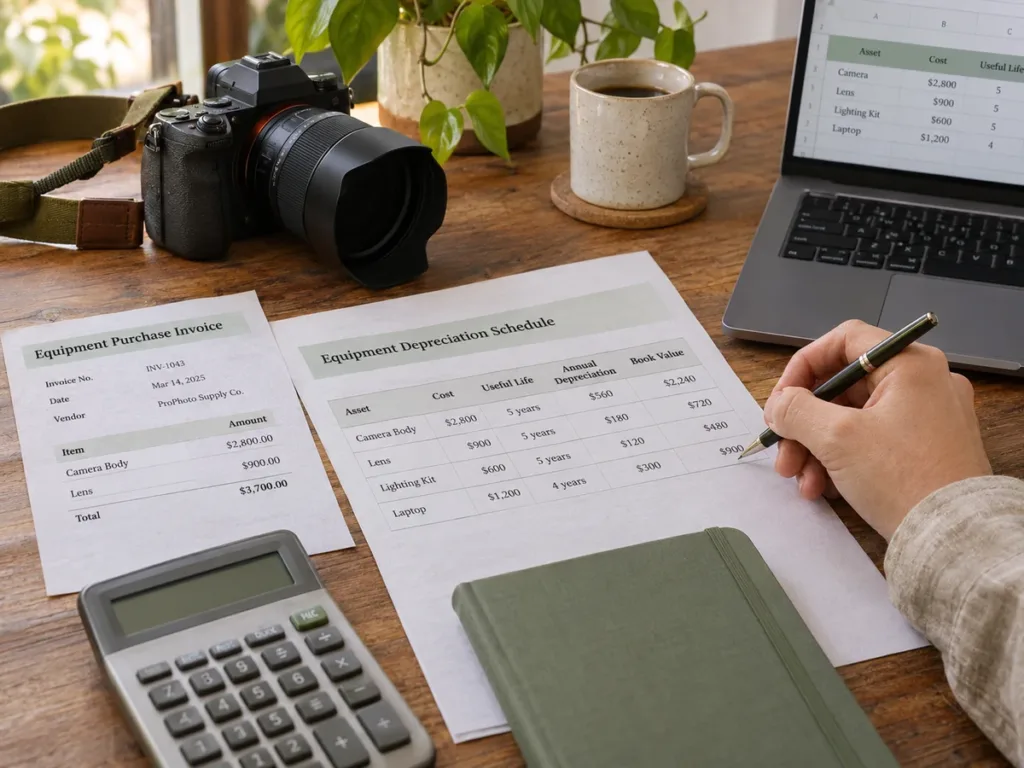
How Depreciation Can Affect Business Taxes
Depreciation for financial reporting and depreciation for tax purposes are related but not always identical.
Tax depreciation allows eligible businesses to recover certain property costs through deductions calculated under applicable tax rules.
These deductions can reduce taxable income when the business qualifies and the relevant requirements are satisfied.
Tax depreciation follows specific rules
For federal income tax purposes, depreciation generally begins when qualifying property is placed in service.
An asset is considered placed in service when it is ready and available for its intended business use.
For example, a business might purchase equipment in December but not finish installation until January.
If the equipment is not ready and available for its intended use until January, tax depreciation generally begins in the later year.
This distinction matters because the purchase date alone does not necessarily determine when depreciation deductions start.
Business use affects eligibility
A business may use certain assets for both personal and business purposes.
For example, an owner might use a vehicle for customer appointments and personal travel.
Only the qualifying business-use portion generally supports depreciation deductions.
Additional rules may apply to vehicles and other property subject to special restrictions.
Accurate records of business use are important for determining the allowable treatment.
Depreciation may reduce taxable income
Consider a business that purchases qualifying machinery.
Depending on current tax rules, the company may be able to recover the cost through depreciation deductions over several years or through available accelerated deductions.
The deduction may reduce taxable income, but it does not necessarily reduce tax liability by the same dollar amount.
The actual tax effect depends on the business’s circumstances, tax rates, elections, and other factors.
Selling depreciated assets can have tax consequences
Depreciation also affects the adjusted tax basis of an asset.
When a business later sells or disposes of that asset, previously claimed or allowable depreciation may influence the calculation of gain or loss.
In some circumstances, depreciation recapture rules can cause part of a gain to be treated as ordinary income.
This is another reason businesses should maintain accurate records of asset costs, depreciation deductions, and disposal dates.
Depreciation vs. Immediate Expense Deductions
One of the most common questions small business owners ask is whether an equipment purchase must be depreciated or can be deducted immediately.
The answer depends on the type of purchase, applicable accounting policies, and current tax rules.
What is an immediate expense deduction?
An immediate deduction generally allows an eligible cost to reduce taxable income in the applicable tax year instead of being recovered through deductions over several years.
Ordinary business expenses, such as qualifying office supplies and routine operating costs, may receive this treatment.
However, larger purchases that create long-term assets may ordinarily need to be capitalized.
What is Section 179?
Section 179 is a federal tax provision that allows eligible businesses to elect to expense the cost of certain qualifying property, subject to applicable requirements and limitations.
For example, a business purchasing qualifying equipment may be eligible to deduct some or all of its cost using Section 179 rather than recovering that amount through regular depreciation.
However, the provision includes restrictions involving eligible property, qualifying use, deduction limits, and taxable business income.
Not every asset or business qualifies.
What is bonus depreciation?
Bonus depreciation is another federal tax provision that can allow an additional first-year deduction for certain qualifying property.
The applicable percentage and eligibility rules depend on current legislation and the property’s acquisition and placed-in-service circumstances.
Businesses should verify the rules for the relevant tax year rather than relying on previous deduction percentages.
What about small purchases?
Certain qualifying purchases may be deducted under applicable safe harbor elections or capitalization policies.
For example, a business might have an established accounting policy for treating lower-cost equipment purchases as expenses.
However, tax treatment may depend on specific requirements, documentation, and elections.
The fact that an item is inexpensive does not automatically establish its proper accounting or tax classification.
Why the distinction matters
Immediate deductions can affect the timing of taxable income, while depreciation spreads cost recovery across applicable periods.
Choosing an available deduction method should involve more than trying to maximize the current year’s expense.
A business should consider current and future tax circumstances, asset use, accounting records, and the consequences of applicable elections.
Common Depreciation Mistakes Small Businesses Make
Depreciation can become confusing when businesses purchase several assets, use different accounting methods, or maintain incomplete documentation.
Recognizing common mistakes can help owners avoid inaccurate financial records.
Recording every equipment purchase as an ordinary expense
Not every equipment purchase should be immediately expensed.
Certain long-term assets may require capitalization and depreciation for financial reporting, even if different deductions are available for tax purposes.
Businesses should review purchases before classifying them.
Using the wrong asset cost
The amount capitalized may include more than the purchase price.
Certain costs directly associated with preparing the asset for its intended use, such as qualifying delivery or installation expenses, may need to be included.
Incorrect asset cost calculations can affect depreciation over several periods.
Confusing useful life with tax recovery periods
The estimated useful life used for financial accounting may differ from the recovery period required under federal tax rules.
For example, equipment expected to remain useful for eight years may have a different tax recovery period.
Businesses should not automatically use the same schedule for both purposes.
Depreciating an asset before it is placed in service
Purchasing an asset does not always mean depreciation can begin immediately.
An item that is not yet ready and available for its intended use may not qualify for depreciation until a later date.
Ignoring personal use
Vehicles and other assets used partly for personal purposes require careful documentation.
Recording 100% business use when the asset also serves personal needs can produce incorrect deductions.
Failing to update asset records
Assets may be sold, retired, exchanged, damaged, or permanently removed from service.
Businesses should update their fixed asset records and determine whether any accounting adjustments or tax consequences apply.
Confusing repairs with improvements
Ordinary repairs generally receive different accounting and tax treatment from capital improvements.
For example, repairing a damaged component may be treated differently from replacing a major system or substantially improving an asset.
The correct classification depends on the nature of the work and applicable rules.
Forgetting previously claimed depreciation
When disposing of an asset, businesses need to know its original basis, accumulated depreciation, and adjusted tax basis.
Missing information can make it difficult to calculate gains, losses, or potential depreciation recapture.
Maintaining organized fixed asset records throughout the year helps prevent these problems.
When to Ask a Tax Professional About Depreciation
Some depreciation questions are straightforward, but others involve tax elections, business-use limitations, and asset classifications that require professional judgment.
Small business owners should consider seeking guidance when a purchase could significantly affect their financial records or tax position.
Situations that may justify professional review include:
- Purchasing expensive machinery, equipment, or business vehicles.
- Deciding whether a cost should be capitalized or expensed.
- Evaluating Section 179 or bonus depreciation eligibility.
- Purchasing property that includes both land and buildings.
- Determining the treatment of major improvements.
- Using assets for both business and personal activities.
- Selling or disposing of previously depreciated property.
- Correcting depreciation errors from earlier tax years.
- Comparing financial accounting depreciation with tax depreciation.
A tax professional can help evaluate the facts, identify applicable rules, and explain how different treatments may affect a business.
This is especially important because depreciation elections and certain accounting decisions can influence more than one tax year.
Businesses should avoid making significant depreciation decisions based only on general examples or software-generated recommendations.
Tax Support in Fort Mill
Understanding depreciation is an important part of maintaining accurate financial records, particularly for businesses that regularly invest in equipment, vehicles, and other long-term assets.
At Abacus Tax & Books, we help small business owners understand their financial information and address accounting and tax-related questions.
Our services include bookkeeping, accounting, tax consulting, tax preparation, and QuickBooks support for small and medium-sized businesses.
Businesses in Fort Mill, Tega Cay, Rock Hill, and surrounding communities may face different depreciation considerations depending on their industries, asset purchases, and business structures.
For example, a contractor purchasing specialized equipment may have different accounting and tax considerations than an office-based business acquiring computers and furniture.
We understand the importance of reviewing financial records carefully and considering how business purchases affect both accounting reports and tax obligations.
Our team works with clients to address tax questions, maintain organized records, and better understand the financial decisions affecting their operations.
Understand Your Business Asset Costs With Abacus Tax & Books
Equipment purchases and other business investments can create important accounting and tax questions.
Knowing whether an asset should be depreciated, how its cost should be recorded, and which tax rules may apply can help business owners avoid preventable mistakes.
At Abacus Tax & Books, we provide accounting and tax support to help small business owners better understand their financial responsibilities.
Our tax consulting and preparation services can help clients evaluate business-related tax questions, while our bookkeeping and QuickBooks support services help maintain organized financial information.
We recognize that depreciation decisions depend on each company’s circumstances. Our approach focuses on reviewing the relevant details rather than assuming the same treatment applies to every purchase.
Whether your business recently acquired equipment, is preparing to invest in new assets, or needs help understanding existing depreciation records, our team is available to discuss your concerns.
Contact Abacus Tax & Books at (803) 548-1099 to schedule a consultation and learn how we can support your business’s accounting and tax needs.
FAQs About Business Depreciation
What is depreciation for small businesses?
Depreciation allocates the cost of qualifying long-term tangible assets over their useful lives. It helps businesses recognize asset costs in financial records and may provide tax deductions under applicable rules.
What business assets can be depreciated?
Qualifying equipment, machinery, furniture, vehicles, buildings, and certain improvements may be depreciated. Land, inventory, and assets used solely for personal purposes generally do not qualify for depreciation.
How is straight-line depreciation calculated?
Subtract the estimated residual value from the asset’s cost and divide the result by its estimated useful life. The method generally produces equal annual depreciation expenses for each full year of use.
Can a small business deduct the full cost of equipment immediately?
Sometimes. Eligible purchases may qualify for Section 179, bonus depreciation, or other applicable deductions. Eligibility depends on current tax rules, asset characteristics, business use, and other limitations.
Does depreciation reduce business taxes?
Depreciation deductions can reduce taxable income when the business qualifies. However, the actual tax effect depends on the business’s tax circumstances, deductions, and applicable rules.
Is depreciation the same for accounting and taxes?
Not necessarily. Financial accounting depreciation generally reflects an asset’s estimated useful life, while tax depreciation follows prescribed recovery methods, elections, and legal requirements. Businesses may need separate schedules for each purpose.