
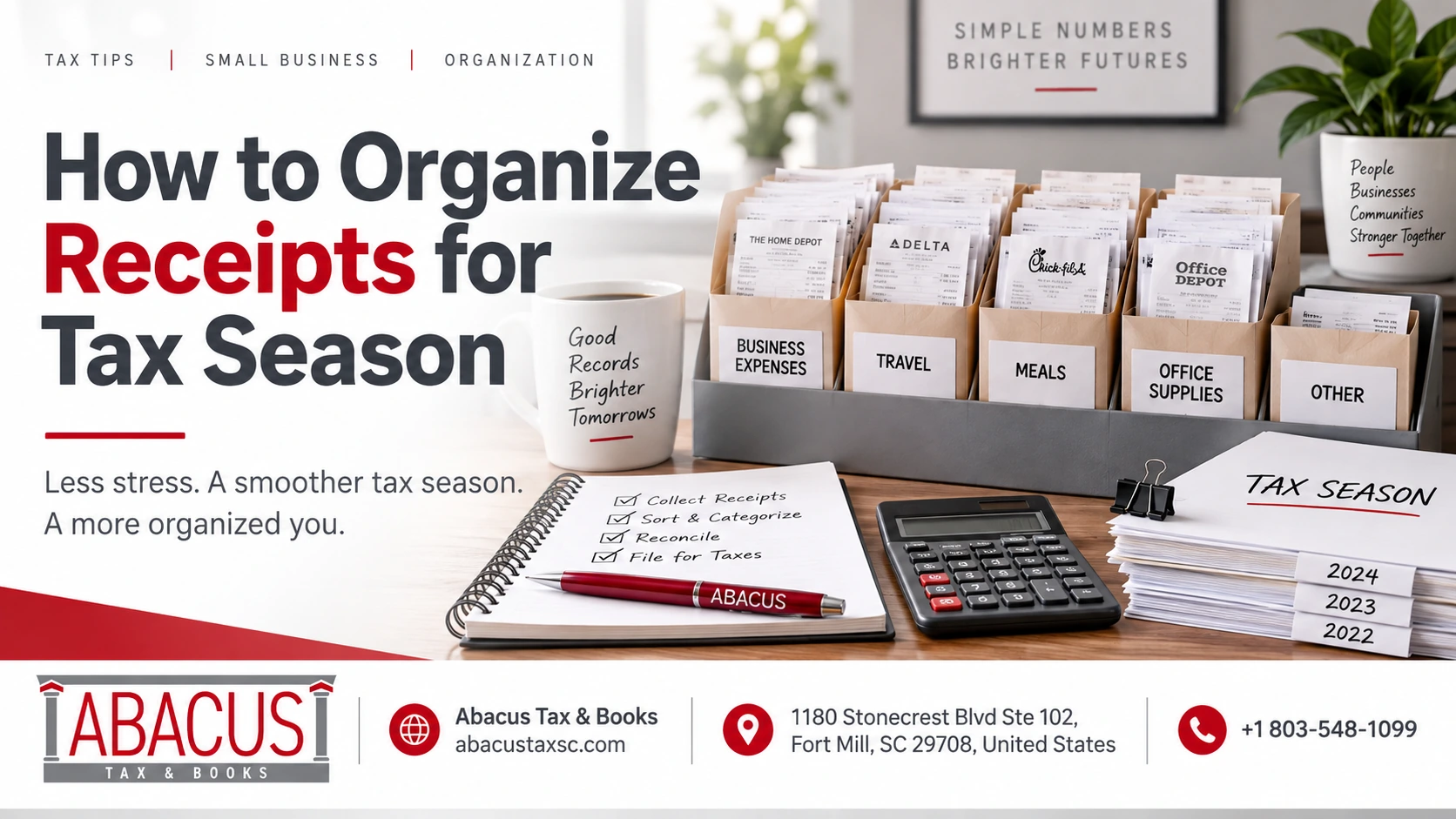
How to Organize Receipts for Tax Season
Knowing how to organize receipts for tax season can make tax preparation easier, reduce missing expense records, and help small business owners maintain more accurate financial information. The best approach is to create a simple system for collecting, categorizing, and storing receipts throughout the year rather than trying to reconstruct everything when a tax deadline approaches.
Receipts are only one part of business recordkeeping, but they provide important support for purchases and expenses reported in the books and on tax returns. The IRS allows businesses to choose a recordkeeping system appropriate for their operations as long as it clearly shows income and expenses.
Why Receipt Organization Matters for Small Businesses
Small business owners often make dozens or hundreds of purchases throughout the year. Office supplies, software subscriptions, equipment, advertising costs, repairs, professional services, and other expenses can quickly become difficult to track without an organized system.
Good receipt organization helps connect each transaction to the accounting records.
That matters because accurate records can help a business:
- Track deductible business expenses
- Prepare financial statements
- Monitor spending
- Identify business versus personal transactions
- Prepare tax returns accurately
- Support amounts reported on a tax return
- Locate documentation if questions arise later
The IRS specifically notes that good records help businesses monitor their progress, prepare financial statements, identify income sources, track deductible expenses, prepare tax returns, and support items reported on those returns.
Receipt organization also improves day-to-day business management.
If an owner waits until tax season to examine an entire year’s worth of purchases, forgotten expenses and unclear transactions become more likely. Recording and organizing expenses when they occur gives the owner and bookkeeper more reliable information throughout the year.
What Business Receipts Should You Keep?
Businesses should keep documents that support entries made in their accounting records and tax returns.
Receipts are important, but they are not the only supporting documents worth retaining.
Depending on the business and transaction, records may include:
- Store and purchase receipts
- Vendor invoices
- Paid bills
- Credit card receipts
- Bank and credit card statements
- Canceled checks
- Electronic payment confirmations
- Deposit records
- Sales invoices
- Subscription invoices
- Equipment purchase documents
- Travel receipts
- Vehicle-related documentation
- Contractor invoices
- Professional service invoices
The IRS identifies receipts, invoices, paid bills, deposit slips, account statements, credit card records, canceled checks, and similar documents as examples of records that can support business transactions.
Keep Documentation That Shows the Business Purpose
A receipt showing that $125 was spent does not always explain why the expense was business-related.
For purchases where the business purpose is not obvious, consider adding a short note.
For example:
Receipt: $85 restaurant charge
Note: Lunch meeting with prospective client regarding website project.
Or:
Receipt: $230 electronics purchase
Note: External monitor purchased for office workstation.
Adding context at the time of the transaction is much easier than trying to remember the purpose nine months later.
Certain expenses, including some travel, transportation, and gift expenses, may have additional substantiation requirements. Business owners should maintain documentation appropriate to the type of expense involved.
How to Organize Paper Receipts
Paper receipts can become difficult to manage because they are small, easy to lose, and sometimes fade over time.
A basic filing system can prevent a desk drawer or shoebox from becoming the primary source of tax records.
Step 1: Create a Temporary Collection Point
Choose one location where all new business receipts go before they are processed.
This might be:
- A labeled envelope
- A desktop receipt tray
- A folder
- An accordion file
- A dedicated compartment in a business bag
The goal is simple: stop receipts from being placed in pockets, vehicles, kitchen counters, and random desk drawers.
Step 2: Sort Receipts Regularly
Set a recurring time to review paper receipts.
Weekly organization is often easier than sorting hundreds of receipts at the end of the year.
During the review, confirm:
- Date
- Vendor
- Amount
- Payment method
- Business purpose
- Expense category
If the receipt does not clearly describe the purchase, add a note while the transaction is still familiar.
Step 3: Organize by Month and Category
One simple filing structure is:
2026 Business Receipts
- January
- February
- March
- April
- And so on
Within each month, receipts can be separated into categories such as:
- Advertising
- Office expenses
- Professional services
- Repairs
- Supplies
- Travel
- Utilities
Alternatively, organize primarily by expense category and then place receipts in date order.
There is no single filing method that works for every business. The important point is to use a consistent system that makes transactions easy to locate. The IRS generally permits businesses to select their own recordkeeping system as long as it clearly reflects income and expenses.
Step 4: Consider Scanning Important Receipts
Paper documentation does not necessarily have to remain paper.
Scanning receipts can create a searchable backup and protect against lost or damaged originals. Businesses should still make sure their electronic records are complete, accurate, organized, and accessible.
How to Store Receipts Digitally
Digital receipt storage can reduce paper clutter and make records much easier to search.
The IRS recognizes electronic recordkeeping systems, and the same basic recordkeeping requirements that apply to paper records also apply to electronically maintained business records.
A simple digital system might include folders such as:
Business Records
- 2026
- January
- February
- March
- 2025
- 2024
Files can then be named consistently.
Instead of:
IMG_4826.jpg
Use something descriptive:
2026-03-12_OfficeDepot_OfficeSupplies_84-50.pdf
A consistent naming convention can include:
- Transaction date
- Vendor
- Expense category
- Amount
This makes individual documents easier to find later.
Use Receipt-Capture or Accounting Software
Many accounting platforms and bookkeeping applications allow businesses to upload or photograph receipts.
Depending on the software, the system may extract information such as:
- Vendor name
- Purchase date
- Amount
- Payment account
- Expense category
Automation can save time, but it should not replace review.
Software may incorrectly categorize an expense or misunderstand a receipt. Business owners or their bookkeepers should periodically review transactions to make sure the books accurately reflect what occurred.
Back Up Digital Records
Do not keep the only copy of important business documents on one computer or phone.
A device can fail, become damaged, or be lost.
Consider maintaining secure backups through an appropriate cloud platform, external storage system, or another reliable backup method.
Whatever system is used, records should remain readable, organized, and accessible for as long as they are required.
How to Categorize Receipts and Business Expenses
Organizing receipts is easier when every transaction follows the same expense categories used in the bookkeeping system.
Common business expense categories may include:
- Advertising and marketing
- Bank and payment-processing fees
- Business insurance
- Contract labor
- Equipment
- Office expenses
- Professional fees
- Rent
- Repairs and maintenance
- Software and subscriptions
- Supplies
- Telephone and internet
- Travel
- Utilities
The appropriate categories depend on the type of business and its tax structure.
A landscaping company’s expenses may look very different from those of a consulting firm, dental practice, retail store, or construction contractor.
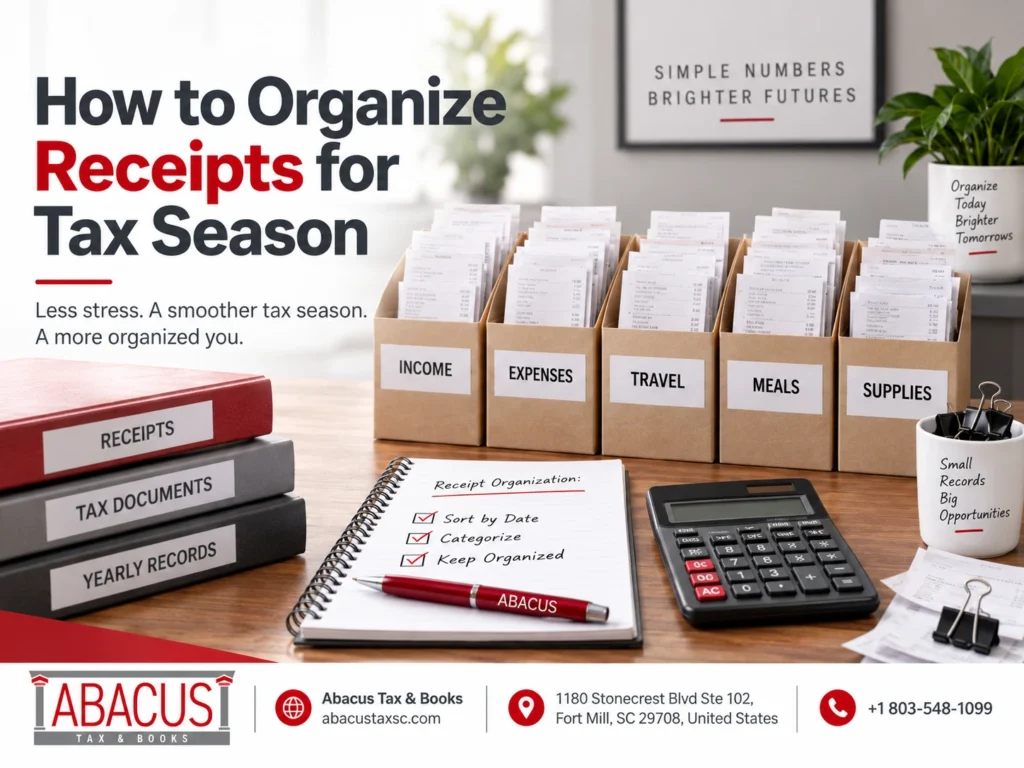
Avoid Creating Too Many Categories
An overly complicated chart of accounts can make bookkeeping more difficult.
For example, creating separate categories for:
- Printer paper
- Pens
- Envelopes
- Staplers
- Notebooks
may provide little practical value when they can reasonably be tracked under an appropriate office-supplies category.
At the same time, categories should not be so broad that important information disappears.
A bookkeeper can help develop a chart of accounts appropriate for the business and maintain consistent treatment from month to month.
Do Not Mix Personal and Business Receipts
A strong receipt system begins with separating business and personal spending.
Using a dedicated business bank account and business credit card can make this much easier.
The IRS recommends keeping the business checking account separate from the owner’s personal checking account because separation improves the ability to record and document business transactions.
If a purchase contains both personal and business items, document the business portion clearly rather than automatically treating the entire transaction as a business expense.
How Long Should You Keep Business Receipts?
There is no universal rule that every receipt should be discarded after exactly three years.
The appropriate retention period depends on what the record supports and the applicable period of limitations.
The IRS states that businesses generally need to keep records supporting income, deductions, or credits until the period of limitations for the related tax return expires. In many ordinary situations, that period is three years, but several exceptions apply.
For example, current IRS guidance includes:
- Generally three years for records supporting an ordinary filed income tax return when certain exceptions do not apply.
- Six years when more than 25% of gross income that should have been reported was omitted.
- Seven years for certain claims involving worthless securities or bad debt deductions.
- At least four years for employment tax records after the tax becomes due or is paid, whichever is later.
- Indefinitely when no return is filed or a fraudulent return is filed.
Records involving business property may need to be kept considerably longer.
Documents relating to equipment, buildings, vehicles, or other business assets may be needed to establish purchase price, improvements, depreciation, and basis. The IRS generally advises retaining property records until the limitation period expires for the year in which the property is disposed of.
Before destroying older records, businesses should also consider whether insurance providers, lenders, state tax agencies, contracts, or other requirements call for longer retention.
Common Receipt Organization Mistakes
Even businesses that save receipts can create problems if their recordkeeping process is inconsistent.
Waiting Until Tax Season
A year’s worth of unorganized receipts is difficult to reconstruct accurately.
Expenses should ideally be recorded when they occur or reviewed at regular intervals throughout the year.
Relying Only on a Bank Statement
A bank or credit card statement proves that money changed hands, but it may not provide enough detail about what was purchased or why the purchase was business-related.
Keep supporting documents when appropriate.
Mixing Business and Personal Spending
Mixed transactions create unnecessary bookkeeping work and make business expenses harder to identify.
Use dedicated business accounts whenever practical.
Saving Receipts Without Categorizing Them
Keeping every receipt in one folder is better than losing them, but it still creates unnecessary work.
Categorize transactions throughout the year.
Keeping Unreadable Digital Photos
A blurry photograph does little good if the vendor, date, or total cannot be read.
Check receipt images immediately after capturing them.
Depending on One Storage Location
Keeping every digital receipt on one laptop or every paper receipt in one filing cabinet creates unnecessary risk.
Maintain appropriate backups.
Forgetting to Document Cash Expenses
Cash purchases are especially easy to overlook.
When cash is used for a legitimate business expense, obtain a receipt and record the transaction promptly.
Best Practices for Staying Organized Year-Round
The easiest tax season usually begins months before the tax return is prepared.
A simple year-round routine can include:
Capture receipts immediately. Photograph or file the receipt before it disappears.
Record expenses regularly. Weekly or monthly bookkeeping reduces the amount of cleanup needed later.
Use consistent categories. Apply the same accounting categories throughout the year.
Reconcile financial accounts. Compare bookkeeping records with bank and credit card statements.
Separate personal and business spending. Dedicated accounts simplify expense tracking.
Review uncategorized transactions. Resolve unfamiliar purchases while they are still recent.
Back up records. Keep secure copies of important financial documents.
Review financial reports. Regular profit-and-loss reviews can identify unusual expenses or missing transactions.
The IRS notes that a recordkeeping system is generally more effective when transactions are recorded as they occur and sources of receipts are properly identified.
A business does not need an overly complicated receipt process. It needs a system that is simple enough to follow consistently.
How Bookkeeping Supports Better Tax Records
Receipt organization and bookkeeping work together.
Receipts provide supporting documentation, while bookkeeping converts individual transactions into organized financial records.
At Abacus Tax & Books, we help small business owners maintain financial records that are easier to understand, review, and prepare for tax season.
Regular bookkeeping can help:
- Record income and expenses consistently
- Categorize business transactions
- Reconcile bank and credit card accounts
- Identify missing documentation
- Separate personal and business activity
- Produce accurate financial reports
- Track business performance throughout the year
- Create cleaner records for tax preparation
Waiting until tax season to organize twelve months of financial activity can lead to missing receipts, forgotten expenses, duplicate entries, and unclear transactions.
A consistent bookkeeping process makes tax preparation less dependent on memory.
It also gives business owners better information during the year. Instead of simply finding out what happened after the year ends, owners can review current revenue, expenses, and profitability while there is still time to make informed business decisions.
Recordkeeping requirements can vary based on the business, type of expense, assets owned, employees, and other circumstances. Professional guidance can help determine which records should be retained and how long they should be kept.
FAQs
Do I need to keep every receipt for my business?
You should keep appropriate documentation supporting the income, expenses, deductions, and credits reported in your business records and tax returns. Depending on the transaction, that documentation may be a receipt, invoice, canceled check, account statement, electronic payment record, or combination of documents.
Are digital copies of receipts acceptable for tax records?
Businesses may maintain records electronically. The IRS states that requirements applying to paper business records also apply to records maintained using electronic accounting or financial systems. Electronic records should remain complete, accurate, and accessible.
Should I organize receipts by month or expense category?
Either approach can work. Many small businesses organize receipts first by year and month and then match them to expense categories in their bookkeeping system. Consistency and the ability to locate documentation are more important than choosing one specific filing structure.
Can I throw away a receipt after entering the expense into accounting software?
Entering an expense into accounting software does not necessarily eliminate the need for supporting documentation. The accounting entry records the transaction, while a receipt, invoice, or other document may provide evidence supporting the amount and business purpose.
How long should I keep receipts after filing my tax return?
Many ordinary income tax records fall under a three-year period of limitations, but that is not a universal retention rule. Some records must be retained for six or seven years, employment tax records generally require at least four years, and records involving business property may need to be kept until after the property is disposed of and the applicable limitation period expires.
What should I do if I lose a business receipt?
Look for other documentation related to the transaction, such as an invoice, bank statement, credit card record, email confirmation, or vendor account history. What is sufficient depends on the type of expense and applicable substantiation requirements, so significant or unusual transactions should be discussed with a tax professional.
Should business receipts and personal receipts be stored separately?
Yes. Keeping business and personal records separate generally makes bookkeeping, expense tracking, and tax preparation much easier. Using dedicated business bank and credit card accounts can further simplify the process.
How often should I organize my business receipts?
Weekly or monthly organization is generally much easier than waiting until tax season. Choose a schedule appropriate for your transaction volume and follow it consistently. Businesses with high transaction volumes may need to process receipts even more frequently.