
Year-Round Tax Calendar for Small Businesses
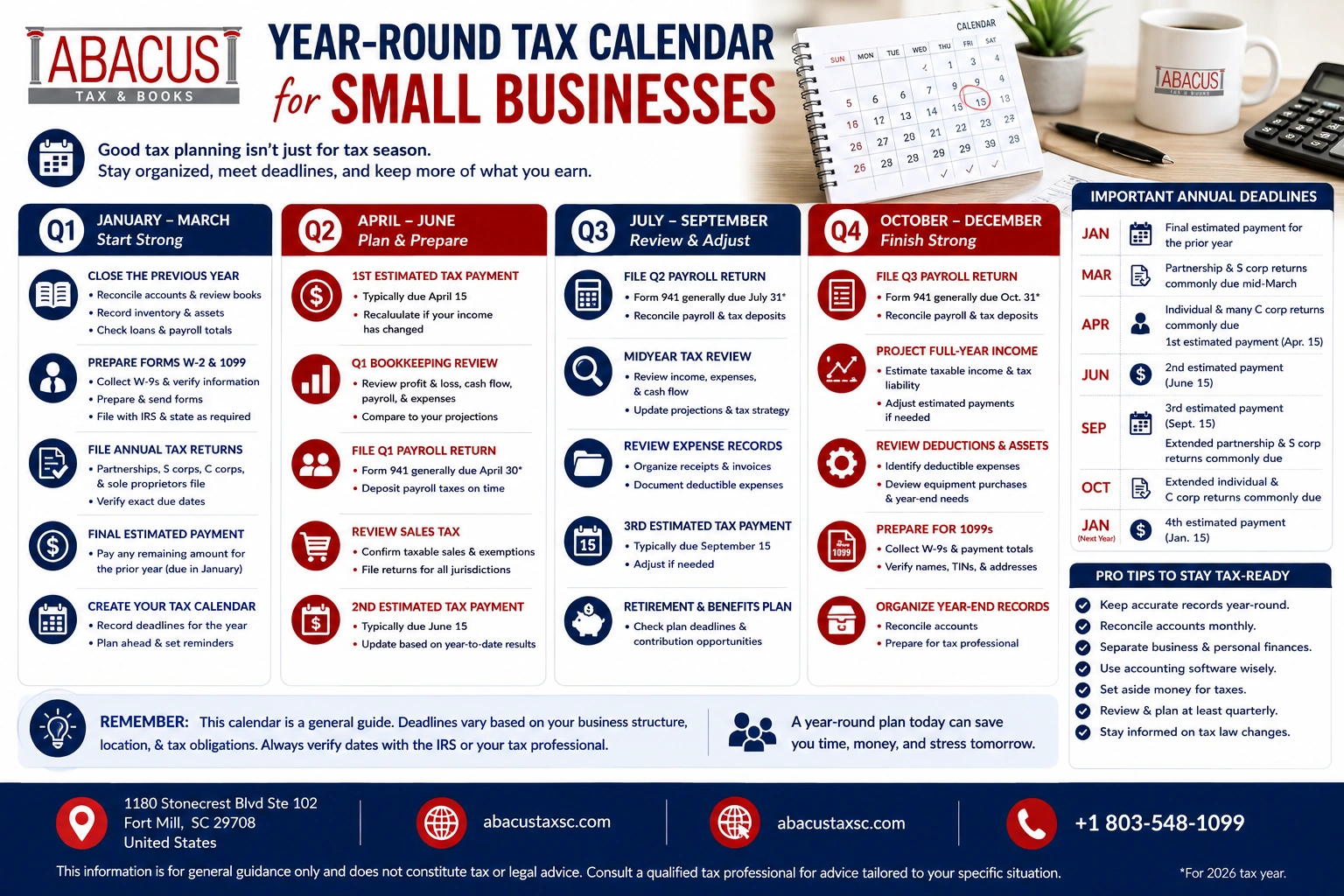
Tax preparation should not begin when a filing deadline is only a few weeks away. For small business owners, tax responsibilities develop throughout the year as income is earned, employees are paid, purchases are made, and business decisions affect the company’s eventual tax position.
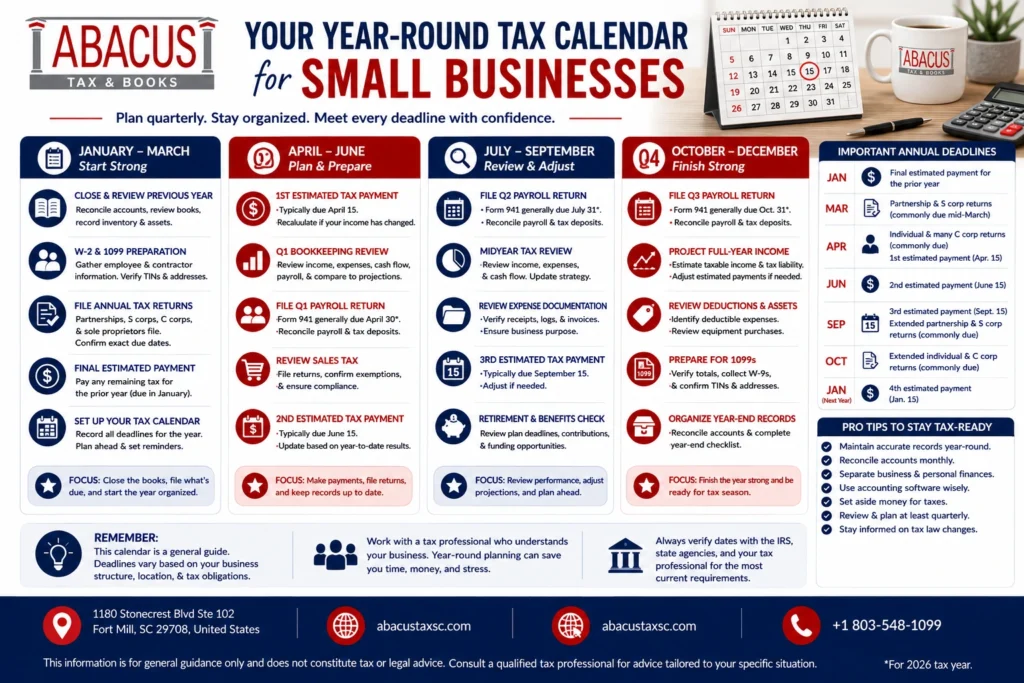
A year-round tax calendar for small businesses helps owners divide these responsibilities into manageable quarterly tasks. Rather than trying to organize an entire year of records at once, businesses can review their finances regularly, address missing information, plan estimated payments, and prepare for upcoming filing requirements.
The exact deadlines that apply to a business depend on its structure, accounting period, payroll schedule, location, and tax obligations. A sole proprietor may follow a different calendar from a partnership, S corporation, C corporation, or limited liability company. State and local requirements can also differ significantly.
The IRS publishes general, employer, and excise tax calendars to help taxpayers identify federal filing and payment dates. Business owners should still verify every deadline using current IRS instructions and guidance from a qualified tax professional.
Why a Year-Round Tax Calendar Matters
Tax obligations do not occur only when an annual return is filed. A business may need to make estimated tax payments, deposit payroll taxes, file quarterly employment returns, submit sales tax reports, issue information returns, and maintain documentation throughout the year.
Without an organized calendar, a business owner may discover too late that a payment was missed, a form was not submitted, or an important record cannot be located.
A year-round calendar can help a business:
- Track federal, state, and local deadlines
- Set aside money for anticipated tax payments
- Maintain accurate bookkeeping records
- Document potentially deductible expenses
- Reconcile bank and credit card accounts
- Review payroll and contractor information
- Prepare for estimated tax payments
- Identify cash flow concerns before deadlines arrive
- Plan retirement contributions and major purchases
- Give a tax professional time to evaluate planning opportunities
Consistent preparation can also improve the quality of financial information used to operate the business. When accounts are reconciled every month or quarter, owners are more likely to notice duplicate charges, missing income, unusual expenses, unpaid invoices, or cash flow problems.
The IRS notes that its tax calendars cover when businesses may need to file returns, make payments, and complete other federal tax actions. Businesses with employees or excise tax responsibilities may need to follow more than one calendar.
First Quarter Tax Responsibilities
The first quarter covers January through March. For many businesses, this is both a filing period and the beginning of a new recordkeeping cycle.
Close the Previous Year’s Books
The year should begin with a complete review of the previous year’s financial records. This commonly includes:
- Reconciling bank accounts
- Reconciling business credit cards
- Reviewing accounts receivable
- Confirming accounts payable
- Categorizing uncoded transactions
- Recording year-end inventory
- Reviewing owner contributions and distributions
- Confirming loan balances
- Checking payroll totals
- Identifying missing receipts or invoices
The objective is to make sure the accounting records support the information that will be reported on the annual return. Waiting until an accountant begins preparing the return can lead to delays, rushed corrections, and avoidable uncertainty.
Prepare Wage and Contractor Information
Businesses with employees generally need to prepare Forms W-2 and related wage reporting. Businesses that made certain reportable payments to independent contractors or other recipients may need to issue the applicable Forms 1099.
Recipient and government filing deadlines can vary by form, payment type, and filing method. Businesses should verify current requirements rather than assuming every information return has the same due date.
Before forms are prepared, the business should confirm:
- Legal names
- Mailing addresses
- Social Security numbers or employer identification numbers
- Total reportable payments
- Employee wage and withholding amounts
- Contractor classifications
- Required state reporting information
Collecting a completed Form W-9 before paying a new contractor can reduce the risk of missing taxpayer information at year-end.
Prepare Annual Income Tax Returns
For calendar-year businesses, annual return deadlines commonly occur in March or April, depending on the entity.
Partnerships generally file an annual information return and pass income or losses through to their partners. S corporations also generally pass tax items through to shareholders. Sole proprietors usually report business activity with their individual returns, while C corporations file separate corporate income tax returns.
Because due dates can shift when they fall on weekends or legal holidays, businesses should confirm the exact date for the applicable year and form.
An extension may provide additional time to file, but it does not necessarily provide additional time to pay. The IRS advises taxpayers that an extension to file is not an extension to pay the tax due.
Review the Final Estimated Payment for the Prior Year
Many sole proprietors, partners, S corporation shareholders, and other individuals with business income make estimated tax payments because their income is not subject to sufficient withholding.
The final individual estimated payment for the previous tax year is generally due in January, although exceptions and alternative filing rules may apply. Taxpayers who do not pay enough during the applicable payment periods may be subject to an underpayment penalty even if they later receive a refund.
Set Up the New Year’s Tax Calendar
The first quarter is a good time to create reminders for:
- Estimated tax payments
- Payroll deposits
- Quarterly payroll returns
- Sales and use tax filings
- Business license renewals
- Annual reports
- Retirement plan milestones
- State franchise or income taxes
- Information return deadlines
- Annual income tax returns
State tax, sales tax, and licensing deadlines should be tracked separately from federal dates.
Second Quarter Tax Responsibilities
The second quarter covers April through June. By this point, businesses should have filed or extended many annual federal returns and should begin evaluating the current year’s financial performance.
Make the First Estimated Tax Payment
For calendar-year individuals, including many sole proprietors, partners, and S corporation shareholders, the first estimated tax payment is generally due in April.
Estimated payments may be required when withholding and refundable credits are not expected to cover enough of the eventual tax liability. Individuals generally consider estimated payments when they expect to owe at least $1,000, while corporations generally consider them when they expect to owe at least $500, although additional rules and exceptions apply.
The payment should be based on more than the previous year’s income when the business has changed significantly. Growth, declining revenue, new employees, major purchases, asset sales, or changes in owner compensation may affect the calculation.
Complete a First-Quarter Bookkeeping Review
After March ends, review the first three months of activity.
The review should include:
- Revenue compared with projections
- Gross profit and operating expenses
- Payroll totals
- Contractor payments
- Owner draws or distributions
- Equipment purchases
- Mileage and vehicle expenses
- Business loan activity
- Estimated tax reserves
- Unusual or one-time transactions
A quarterly review gives the owner and tax professional an opportunity to update projections while there is still time to act.
File First-Quarter Payroll Reports
Many employers use Form 941 to report wages, federal income tax withholding, Social Security tax, and Medicare tax. The first-quarter Form 941 is generally due at the end of April, although certain employers follow different reporting rules.
Filing a payroll return and depositing payroll taxes are separate responsibilities. Federal tax deposits may be required on a semiweekly or monthly schedule rather than only when the quarterly return is due.
Employers should not assume that submitting Form 941 satisfies any earlier deposit obligation.
Review Sales Tax Requirements
Businesses selling taxable goods or services may have monthly, quarterly, semiannual, or annual sales tax obligations. Requirements differ by state, locality, sales volume, and the products or services sold.
A second-quarter review should confirm that:
- Sales tax was collected where required
- Taxable and nontaxable sales were categorized correctly
- Exemption certificates are current
- Marketplace sales were treated properly
- Returns were filed for every registered jurisdiction
- Collected funds were not used for operating expenses
Even when no taxable sales occurred, a business may still be required to file a zero return.
Make the Second Estimated Tax Payment
The second estimated payment for calendar-year individuals is generally due in June. The estimated-tax calendar does not divide the year into four equal three-month periods, which is one reason owners should record the actual deadlines rather than relying on the phrase “quarterly taxes.”
Before making the payment, compare year-to-date results with the assumptions used for the first payment.
Third Quarter Tax Responsibilities
The third quarter covers July through September. This is an important period for evaluating whether the business is on track and identifying tax-planning opportunities before year-end.
File Second-Quarter Payroll Reports
For employers required to file Form 941, the second-quarter return is generally due at the end of July. The IRS’s 2026 calendar, for example, lists July 31, 2026, as the second-quarter Form 941 due date.
Businesses should also reconcile payroll reports with:
- General ledger payroll accounts
- Payroll service reports
- Federal tax deposits
- State withholding reports
- Unemployment tax records
- Employee benefit deductions
Differences found during the summer are generally easier to address than discrepancies discovered while preparing year-end wage forms.
Conduct a Midyear Tax Review
A midyear review should compare actual business performance with the annual forecast.
Questions to discuss may include:
- Is taxable income higher or lower than expected?
- Are estimated payments still appropriate?
- Have new revenue streams been added?
- Has the business hired employees or contractors?
- Were assets purchased, sold, or traded?
- Has the ownership structure changed?
- Did the business expand into another state?
- Are there new sales tax obligations?
- Are retirement contributions on schedule?
- Are owner wages or distributions being handled properly?
This review is especially important after a major change such as opening a second location, receiving a large contract, purchasing equipment, losing a major client, or changing entity classification.
Review Expense Documentation
By the third quarter, businesses often have accumulated months of receipts and digital documents. This is a good time to verify that records are complete.
Potential documentation may include:
- Vendor invoices
- Proof of payment
- Travel records
- Mileage logs
- Business meal details
- Equipment purchase documents
- Loan statements
- Insurance records
- Home office information
- Professional fee invoices
- Charitable contribution records
- Employee reimbursement reports
A bank or credit card statement may show that money was spent, but it may not establish the business purpose of the expense. Records should explain what was purchased, when it was purchased, how much it cost, and how it related to the business.
Make the Third Estimated Tax Payment
The third individual estimated tax payment is generally due in September. Business owners should recalculate their expected annual income rather than automatically paying the same amount each period when financial results have changed.
The IRS allows estimated taxes to be paid more frequently, such as weekly or monthly, as long as enough has been paid by the applicable payment deadline. This may help some owners manage cash flow and avoid holding a large payment until the final day.
Begin Retirement and Benefit Planning
Some retirement plan decisions must be made before year-end, even when contributions can be completed later. Available options and deadlines depend on the type of plan, entity, employee count, compensation, and applicable tax law.
The third quarter gives business owners time to discuss:
- Plan establishment deadlines
- Employer contribution estimates
- Employee eligibility
- Owner contribution opportunities
- Payroll deferrals
- Administrative requirements
- Cash needed to fund contributions
Retirement planning should be coordinated with a qualified tax or financial professional rather than treated solely as a year-end deduction strategy.
Fourth Quarter Tax Responsibilities
The fourth quarter covers October through December. This is the final opportunity to organize the current year’s records and evaluate many strategies before the tax year closes.
File Third-Quarter Payroll Reports
Employers that file Form 941 generally submit the third-quarter return around the end of October. Businesses should verify that federal deposits, state withholding, payroll records, and accounting entries agree before the year-end reporting process begins.
Project Full-Year Income and Tax
A fourth-quarter projection should include income and expenses already recorded, as well as reasonable estimates for the remaining weeks of the year.
The projection can help determine:
- Whether estimated payments need adjustment
- How much cash to reserve
- Whether payroll needs correction
- Whether owner compensation needs review
- Whether planned purchases fit the business budget
- Whether retirement contributions are feasible
- Whether a large transaction creates a tax issue
- Whether an extension may be necessary
Tax decisions should support the needs of the business. Spending money solely to obtain a possible deduction does not automatically improve cash flow or profitability.
Review Potentially Deductible Expenses
Small businesses frequently overlook expenses because records are incomplete or personal and business transactions have been mixed.
A year-end review may identify business-related costs involving:
- Advertising
- Software
- Professional services
- Insurance
- Office supplies
- Business travel
- Employee education
- Equipment
- Repairs and maintenance
- Rent
- Utilities
- Bank fees
- Merchant processing
- Business licenses
- Qualified vehicle use
Whether an expense is deductible depends on the facts, its business purpose, current tax rules, and the taxpayer’s circumstances. Owners should not assume that every purchase made through a business account qualifies.
Review Equipment and Asset Purchases
Before purchasing equipment for tax reasons, consider:
- Whether the business actually needs it
- Whether it will be placed in service before year-end
- Whether it should be expensed or depreciated
- How financing affects cash flow
- Whether special deduction rules apply
- Whether state treatment differs from federal treatment
An item generally must be ready and available for its intended business use before it is considered placed in service. Simply ordering or paying for equipment may not always produce the expected result.
Prepare for Information Returns
The fourth quarter is the best time to review contractor and vendor records before Forms 1099 are prepared.
Businesses should identify missing:
- Forms W-9
- Taxpayer identification numbers
- Legal names
- Current addresses
- Entity classifications
- Payment totals
Waiting until January to request missing information can create delays and increase the risk of incorrect reporting.
Organize Year-End Records
Before December ends, create a checklist for:
- Bank reconciliations
- Credit card reconciliations
- Inventory counts
- Fixed asset records
- Accounts receivable
- Bad debts
- Accounts payable
- Loan balances
- Payroll records
- Contractor totals
- Owner transactions
- Retirement contributions
- Estimated payments
- Sales tax reports
The cleaner the records are at year-end, the easier it is to prepare an accurate return and respond to questions from the tax professional.
Important Annual Tax Deadlines to Remember
The following are common federal milestones for calendar-year businesses. They are general planning reminders, not a complete list of filing requirements:
| Time of year | Common responsibility |
| January | Final estimated payment for the prior year; wage and information-return preparation |
| March | Calendar-year partnership and S corporation returns are commonly due around the middle of the month |
| April | Individual, sole proprietor, and many C corporation returns are commonly due; first individual estimated payment |
| June | Second individual estimated payment |
| September | Third individual estimated payment; extended partnership and S corporation returns are commonly due |
| October | Many extended individual and C corporation returns are commonly due |
| January of the following year | Fourth individual estimated payment for the preceding tax year |
For the 2026 tax year, the standard individual estimated-payment dates are generally April 15, June 15, and September 15, 2026, followed by January 15, 2027. Special rules apply in some situations, including certain farming and fishing income.
Quarterly Form 941 returns are generally due after each calendar quarter. The 2026 IRS schedule lists April 30, July 31, and October 31, 2026, followed by February 2, 2027, because the usual fourth-quarter deadline is affected by the calendar.
These dates do not cover every payroll deposit, excise tax, sales tax, franchise tax, annual report, or state requirement. Fiscal-year businesses also follow different income tax filing dates.
When a federal deadline falls on a Saturday, Sunday, or legal holiday, it generally moves to the next business day.
Common Small Business Tax Calendar Mistakes
Waiting Until Tax Season
Tax season is too late to reconstruct an entire year efficiently. Missing receipts, uncategorized transactions, and inaccurate balances may require hours of additional work.
Quarterly reviews distribute that work throughout the year.
Missing Estimated Payments
Some owners assume they can pay all taxes when the annual return is filed. Depending on the circumstances, failing to make sufficient payments during the year can result in an underpayment penalty.
The IRS divides the year into separate estimated-payment periods and may assess a penalty when enough tax was not paid by the applicable deadline.
Treating Payroll Filing and Depositing as the Same Task
Employers may file payroll returns quarterly while being required to deposit taxes more frequently. Missing a deposit because the quarterly return is not yet due can create penalties.
Mixing Business and Personal Expenses
Using the same account for business and personal spending makes bookkeeping more difficult and can obscure the purpose of transactions. Separate accounts do not determine deductibility by themselves, but they make recordkeeping clearer.
Overlooking Deductible Expenses
Expenses may be missed when receipts are not saved, mileage is not logged, or employees and owners use personal funds without documenting reimbursements.
Failing to Reconcile Accounts
Accounting software does not guarantee accurate books. Bank, credit card, payroll, loan, and merchant accounts still need to be reconciled against external statements.
Ignoring State and Local Deadlines
Federal filings are only one part of the calendar. A business may also have state income tax, sales tax, franchise tax, payroll, property tax, licensing, and annual report responsibilities.
Assuming an Extension Delays Payment
An extension generally gives a taxpayer additional time to submit a return, not additional time to pay the amount due.
Pro Tips for Staying Tax-Ready All Year
Maintain Digital Records
Save receipts, invoices, statements, contracts, and tax documents in a secure digital filing system. Organize folders by year, month, and record type.
Use clear file names rather than relying on a folder filled with unlabeled scans or photographs.
Schedule Monthly Bookkeeping Time
Set aside time every month to:
- Categorize transactions
- Upload receipts
- Send invoices
- Review unpaid bills
- Reconcile accounts
- Update mileage
- Examine cash flow
A short monthly process is usually easier than a large year-end cleanup.
Hold Quarterly Financial Reviews
Review the balance sheet, profit and loss statement, cash flow, payroll, estimated payments, and upcoming obligations at least once each quarter.
A financial statement should not be accepted merely because the accounting software produced it. Review unusual balances and ask what the numbers mean.
Separate Business and Personal Finances
Use dedicated business bank accounts and credit cards. Establish a consistent process for owner contributions, distributions, reimbursements, and personal expenses accidentally paid by the business.
Use Accounting and Payroll Software Carefully
Software can automate recurring transactions, reports, invoicing, and payroll calculations. However, setup errors can repeat throughout the year.
Review account mappings, payroll settings, tax rates, and automated rules regularly.
Keep a Dedicated Tax Reserve
Consider moving a portion of business income into a separate savings account for estimated taxes and other obligations. The appropriate amount depends on profitability, entity structure, withholding, location, and individual circumstances.
Monitor Official Updates
Tax rules, forms, payment methods, and deadlines can change. The IRS recommends using the current form instructions and tax calendar for the latest filing and payment information.
How Professional Tax Preparation Supports Year-Round Planning
Professional tax preparation involves more than entering annual totals into a return. When a tax professional is involved throughout the year, they may help a business understand which deadlines apply, what documentation should be maintained, and how current activity could affect future filings.
Year-round support may include:
- Developing a customized deadline calendar
- Reviewing estimated tax requirements
- Identifying missing bookkeeping information
- Evaluating entity-specific filing responsibilities
- Coordinating payroll and income tax records
- Reviewing changes in business activity
- Preparing year-end document requests
- Explaining the effect of major transactions
- Monitoring federal and state obligations
- Reducing last-minute filing problems
A tax preparer does not replace the business owner’s responsibility to maintain accurate records and provide complete information. However, regular communication can help identify questions while there is still time to resolve them.
The most useful calendar is one tailored to the business. A company with employees, inventory, multiple owners, and sales in several states will need a more detailed schedule than a sole proprietor with no payroll.
Professional guidance can help separate general reminders from the deadlines and planning opportunities that actually apply.
FAQs
What is a year-round tax calendar for small businesses?
It is a schedule that organizes tax-related responsibilities by month or quarter. It may include estimated payments, payroll filings and deposits, bookkeeping reviews, sales tax returns, annual income tax filings, information returns, and planning meetings.
Do all small businesses have the same tax deadlines?
No. Deadlines depend on the business structure, tax year, employees, location, industry, and specific taxes involved. State and local requirements may differ from federal rules.
When are quarterly estimated tax payments due?
For calendar-year individuals, including many sole proprietors, partners, and S corporation shareholders, payments are generally due in April, June, September, and January of the following year. Corporations follow separate estimated-tax rules. Owners should verify the current dates and requirements for their situation.
Are estimated tax periods three months long?
Not always. Although estimated payments are commonly described as quarterly, the federal payment periods are not four equal calendar quarters. Record the actual due dates instead of assuming a payment is due every three months.
How often should a small business review its books?
Transactions should generally be recorded and reconciled monthly, with a more detailed financial and tax review at least quarterly. Businesses with high transaction volume may need more frequent reviews.
Does filing an extension extend the payment deadline?
Generally, no. An extension typically gives additional time to file the return, but the expected tax must still be paid by the original payment deadline.
What records should a small business keep throughout the year?
Common records include income reports, bank statements, receipts, invoices, payroll records, contractor information, mileage logs, loan statements, equipment records, sales tax reports, and proof of estimated payments.
The necessary records depend on the business and the items reported on its returns.
Should business and personal expenses be kept separate?
Yes. Separate bank and credit card accounts make it easier to document business activity, reconcile records, and identify owner transactions. A separate account does not automatically make an expense deductible, but it improves organization.
Can accounting software replace a tax professional?
Accounting software can help record and organize transactions, but it does not necessarily determine which tax rules apply or whether the records are complete. A qualified tax professional can provide guidance based on the business’s structure and circumstances.
What happens if a tax deadline falls on a weekend?
Federal filing deadlines that fall on a Saturday, Sunday, or legal holiday generally move to the next business day. State rules should be checked separately.
When should a business contact a tax professional?
A business should consider professional guidance when it starts operations, hires employees, changes ownership, expands into another state, purchases or sells major assets, changes entity structure, experiences significant growth, or is uncertain about a filing or payment requirement.
Make Tax Preparation a Routine Business Process
A year-round tax calendar forsmall businesses turns tax preparation into an ongoing process rather than an annual emergency.
By maintaining records monthly, reviewing finances quarterly, tracking estimated payments, monitoring payroll obligations, and planning for year-end, owners can approach filing deadlines with more complete information and fewer surprises.
No general calendar can account for every business structure, state requirement, or tax situation. Verify current deadlines using IRS guidance, the instructions for the applicable forms, and advice from a qualified tax professional familiar with the business.